
NCLEX-PN® Exam: What LPN and LVN Candidates Should Know
The NCLEX-PN® is the licensing exam for graduates of practical nursing and vocational nursing programs. Boards of nursing use it to decide whether a candidate can practice safely as an entry-level licensed practical or vocational nurse (LPN/VN). Many candidates assume it is a shorter version of the RN exam. It is not. It has its own test plan, its own emphasis, and its own definition of what an LPN/VN is accountable for, so preparing from the right blueprint matters from the first study session.
Every number here comes from the National Council of State Boards of Nursing (NCSBN), the organization that develops the exam, and reflects the 2026 NCLEX-PN® Test Plan that took effect in April 2026.

How the NCLEX-PN® Exam Works
Like the RN exam, the NCLEX-PN uses computerized adaptive testing. The computer builds a unique exam as you answer, re-estimating your ability after every question and selecting the next one from a large pool while staying within the content percentages of the PN test plan. Every candidate answers between 85 and 150 questions within five hours, and that limit includes breaks. There is no time limit on any single question, but once you confirm an answer and move on, you cannot return to it.
What Makes Up the Shortest Exam
Of the 85 questions in the shortest possible exam, 52 are scored content questions drawn from the eight content areas, 18 belong to three clinical judgment case studies, and 15 are unscored pretest questions. Pretest questions cannot be told apart from scored ones, so every question deserves your full attention.
How the Exam Stops
After you reach 85 questions, the exam ends as soon as the computer is 95% certain your ability is clearly above or clearly below the passing standard. If your ability is very close to the standard, the exam continues to 150 questions and the final ability estimate decides. If time runs out first, falling short of the minimum is a fail, and otherwise your final ability estimate decides. NCSBN is explicit that the length of your exam does not indicate whether you passed or failed, so there is nothing to gain from counting questions.
What the 2026 Test Plan Covers for Practical Nurses
The test plan has four Client Needs categories, and two of them are divided into subcategories, which gives eight content areas. Each area has a percentage range that the computer keeps your exam inside, and because exam length varies, an individual exam can drift from those ranges by up to three percentage points.
| Content area | Share of items | What to practice (examples from NCSBN) |
|---|---|---|
| Coordinated Care | 18 to 24% | Assigning tasks to assistive personnel, monitoring their work, prioritizing care, advocating for client rights, informed consent, handoff report |
| Safety and Infection Prevention and Control | 10 to 16% | Verifying client identity, safe handling and transfer devices, allergies, least restrictive restraints, personal protective equipment and isolation |
| Health Promotion and Maintenance | 6 to 12% | Developmental milestones, antepartum and postpartum care, immunizations, health screening, health history |
| Psychosocial Integrity | 9 to 15% | Therapeutic communication, coping, de-escalation, signs of substance misuse, cognitive impairment, end-of-life care |
| Basic Care and Comfort | 7 to 13% | Mobility, nutrition and enteral feeding, activities of daily living, skin integrity, pain rating scales, comfort measures |
| Pharmacological Therapies | 10 to 16% | Rights of medication administration, oral and injectable routes, IV piggyback, flow rate calculations, adverse reactions |
| Reduction of Risk Potential | 9 to 15% | Vital sign monitoring, specimen collection, blood glucose checks, catheter and tube care, pre- and postoperative care, laboratory results |
| Physiological Adaptation | 7 to 13% | Wound care, tracheostomy and ventilator care, ostomy care, fluid and electrolyte imbalances, recognizing and reporting changes, emergencies |
Coordinated Care is the largest single area, and the four Physiological Integrity subcategories together make up roughly 45 percent of items. That means delegation and teamwork questions deserve as much study time as medications and procedures, which surprises many candidates.
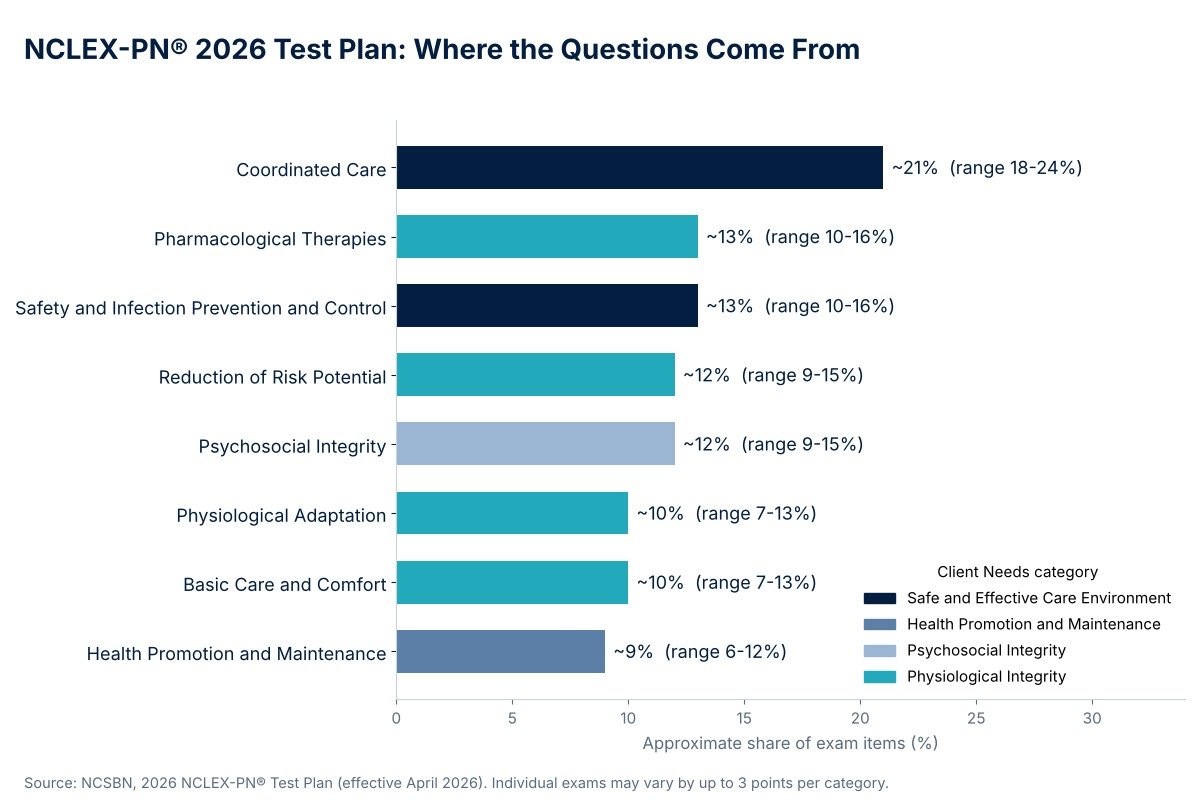
NCSBN reviews the test plan every three years, and the 2026 version draws on a 2024 practice analysis in which more than 26,000 newly licensed LPN/VNs described their work. According to NCSBN, the Client Needs percentage ranges were retained, one subcategory was renamed (it is now Safety and Infection Prevention and Control), and new activity statements were added. A blueprint walkthrough by Client Needs category shows how each area is tested in more detail.
How the PN Plan Differs from the RN Plan
Both exams share the same four categories, but the weighting and the scope of practice are not the same. The registered nurse licensure exam is built for a different level of responsibility, which is why material written for one license can mislead a candidate preparing for the other.
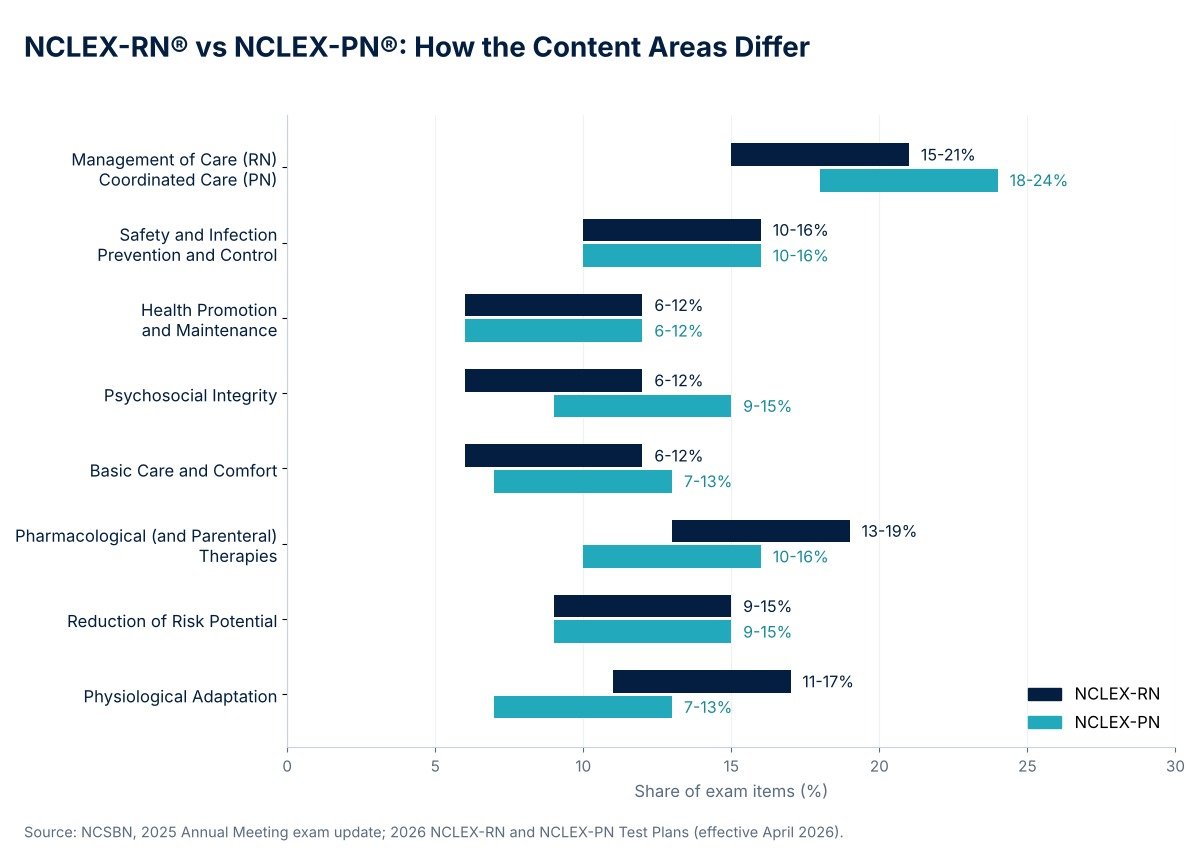
- Coordinated Care replaces Management of Care. It carries 18 to 24% of PN items, compared with 15 to 21% for Management of Care on the RN exam, and it centers on assigning tasks and monitoring the work of assistive personnel.
- Psychosocial Integrity weighs more. It is 9 to 15% on the PN exam and 6 to 12% on the RN exam.
- Pharmacology is named and weighted differently. The PN content area is called Pharmacological Therapies and carries 10 to 16%, while the RN area adds Parenteral and carries 13 to 19%.
- Physiological Adaptation is lighter. It is 7 to 13% for PN candidates and 11 to 17% for RN candidates.
- The language of the tasks reflects scope. PN activity statements describe assisting, participating, and reinforcing education, and NCSBN describes the entry-level LPN/VN as caring for clients with commonly occurring health problems that have predictable outcomes.
Clinical Judgment and Next Generation Item Formats
Clinical judgment is measured on the PN exam just as it is on the RN exam. Each exam includes three case studies of six questions that follow one client as new information unfolds, plus about 10% stand-alone clinical judgment items. The six steps are recognizing cues, analyzing cues, prioritizing hypotheses, generating solutions, taking action, and evaluating outcomes. Reviewing the Next Generation item types before test day, including bow-tie, trend, matrix, and drag-and-drop questions, keeps the screen from slowing you down.
How to Study for the NCLEX-PN® Exam
Practical nursing candidates often study around work shifts, family responsibilities, and clinical hours, so the plan has to be realistic before it can be effective. Rereading notes feels productive, but the exam asks you to retrieve and apply knowledge. Answering questions from memory and then studying why each option is right or wrong is one of the best-supported ways to learn.
Study from PN-Scoped Material
A question can have a different best answer depending on whose scope of practice it describes. NCSBN's own PN sample item on assigning care to assistive personnel shows why: the strongest instruction is the one that is specific about distance, frequency, and start time, because assistive personnel need a task they can carry out exactly as written. PrepNurse.ai gives practical nursing candidates a program track of their own, separate from NCLEX-RN, as part of its full set of NCLEX study resources.
Study Habits for the NCLEX-PN® Exam
Short, consistent sessions beat occasional marathons. The free plan includes the Question of the Day plus Quick 10 and Quick 20 sets, which fit into a lunch break or the gap between shifts, and Premium adds Timed Quiz and AI Quiz. Rotating through the available quiz modes builds knowledge and the stamina to stay focused through an adaptive exam.
Read every rationale, including for questions you answered correctly, and ask what cue in the scenario pointed to the answer. Once your results show which content areas are weakest, a written adaptive study schedule lets you put your limited hours where they will matter most.
Rehearse Delegation and Prioritization
Because Coordinated Care is the biggest single area, scenario practice that forces you to decide who does what, and what comes first, is time well spent. Games such as the Emergency Room Challenge, Infection Control Simulator, and Drug Match Challenge put you in a situation where your choices have consequences. These clinical decision games are a Premium feature.
The Question of the Day and short quizzes stay free, so you can compare the free and Premium plans and decide what fits your timeline and budget.
Registration and Retesting for the PN Exam
To sit for the exam, you register with Pearson VUE and apply to your state or territorial board of nursing, which determines your eligibility. The Pearson VUE registration fee for U.S. licensure is currently $200, and your board may charge its own licensure fee. NCSBN has announced that registrations completed on or after February 1, 2027 will cost $350, and the date you register, not the date you test, decides which fee applies. Fees and rules can change, so confirm current details in the candidate bulletin on the official NCLEX website before you register.
If you do not pass, NCSBN requires 45 test-free days between attempts and allows up to eight attempts per year, although a jurisdiction can set stricter rules.
If you are unsure which exam applies to your program or how to fit studying around your schedule, you can talk with the support team before you start.
NCLEX-PN® Exam Frequently Asked Questions
How many questions are on the NCLEX-PN®?
Every candidate answers at least 85 questions and no more than 150, within a five-hour limit that includes breaks. Of the 85 questions in the shortest exam, 52 are scored content questions, 18 belong to three clinical judgment case studies, and 15 are unscored pretest questions.
What is Coordinated Care on the NCLEX-PN®?
Coordinated Care is the largest single content area on the PN test plan at 18 to 24% of items. It covers how an LPN/VN works within the care team, including assigning tasks to assistive personnel, monitoring their activities, prioritizing care, advocating for client rights, participating in informed consent, and giving and receiving handoff report.
Is the NCLEX-PN® an adaptive exam?
Yes. The exam uses computerized adaptive testing. After each answer the computer re-estimates your ability and selects the next question you are expected to find challenging, while keeping the exam within the test plan percentages. After the minimum of 85 questions, it ends once it is 95% certain your ability is clearly above or below the passing standard.
What changed in the 2026 NCLEX-PN® test plan?
The 2026 plan took effect in April 2026 and is based on NCSBN's 2024 PN practice analysis. According to NCSBN, the Client Needs percentage ranges were retained, the Safety and Infection Control subcategory was renamed Safety and Infection Prevention and Control, and new activity statements were added. NCSBN reviews the plan every three years.
How is the NCLEX-PN® different from the NCLEX-RN®?
Both exams use four Client Needs categories, adaptive testing, and the same 85 to 150 question range. The PN plan has Coordinated Care where the RN plan has Management of Care, gives Psychosocial Integrity more weight, gives Pharmacological Therapies and Physiological Adaptation less weight, and describes tasks at the LPN/VN scope of practice.
How much does the NCLEX-PN® cost, and is the fee changing?
The registration fee for U.S. licensure is currently $200 and is paid to Pearson VUE, separate from any fee your board of nursing charges. NCSBN has announced that the fee will be $350 for registrations completed on or after February 1, 2027. The registration date, not the exam date, determines the fee, retakes carry the same fee, and registration fees are not refundable.
How soon can I retake the NCLEX-PN® if I do not pass?
NCSBN policy requires 45 test-free days between attempts and allows up to eight attempts per year. Your state or territorial board of nursing can set stricter limits, so check with your board before planning a retake date. You must register with Pearson VUE again for each attempt.
Start Practicing at Your Own Pace
Preparation works best when it is steady, honest about weak areas, and focused on understanding why answers are right. PrepNurse.ai offers a free plan that needs no credit card, so you can answer your first questions, read the rationales, and see where you stand today.
PrepNurse.ai is an independent study resource and is not affiliated with or endorsed by NCSBN. NCLEX®, NCLEX-RN®, and NCLEX-PN® are registered trademarks of NCSBN. PrepNurse.ai is a study aid and does not guarantee an exam result.