
NCLEX-RN® Test Plan 2026: Content Areas Explained
The NCLEX-RN® test plan is the blueprint NCSBN uses to decide what the exam covers and how much of it each topic receives. Most candidates open it expecting a list of nursing specialties and find something else: eight content areas with percentage ranges and long lists of nursing activities. Read correctly, it is the most reliable study map you can get, because it tells you what an entry-level nurse is expected to do and how often each kind of decision appears on the exam.
Every figure here comes from NCSBN's 2026 NCLEX-RN® Test Plan, which took effect in April 2026, and from NCSBN's 2025 Annual Meeting exam update.

The NCLEX-RN® Test Plan at a Glance
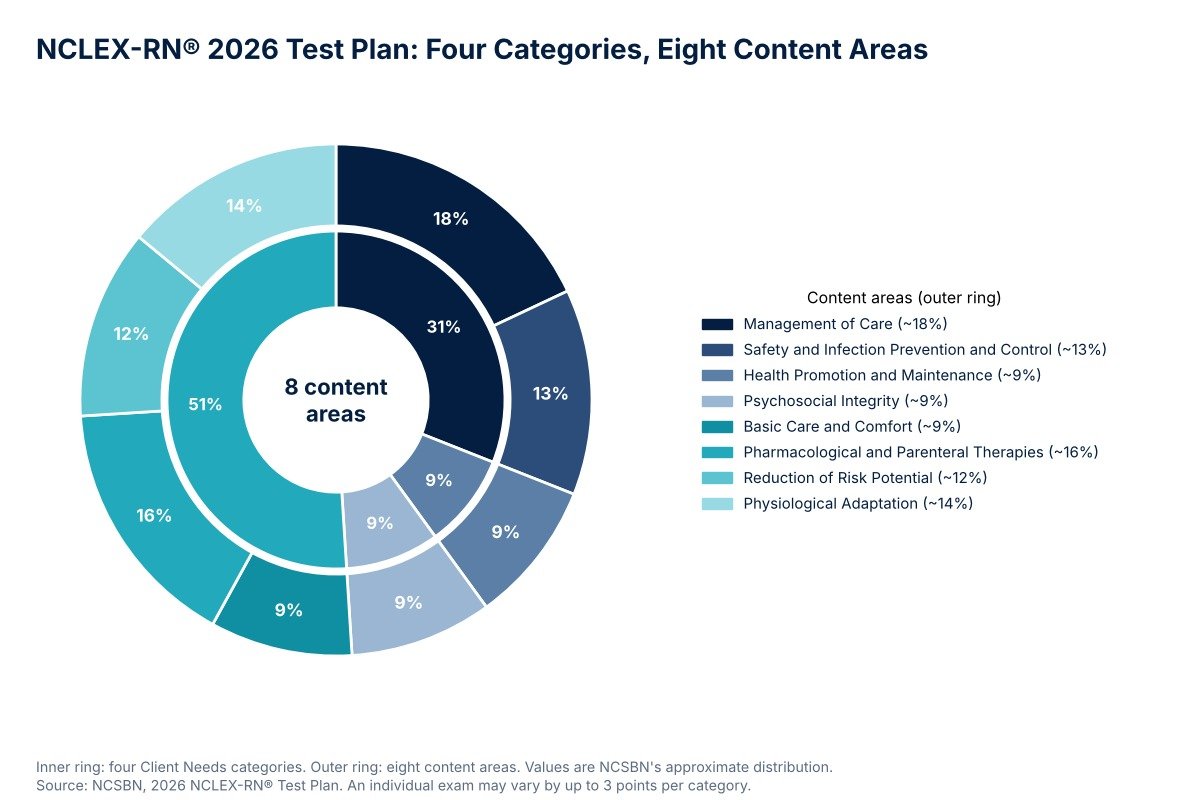
The test plan organizes the exam into four Client Needs categories. Two of them, Safe and Effective Care Environment and Physiological Integrity, are divided into subcategories, which gives eight content areas in total. Each area carries a percentage range, and the adaptive exam keeps your questions within those ranges. Because exam length varies from 85 to 150 questions, an individual exam can differ from the ranges by up to three percentage points in each area.
Six processes run through every category: caring, clinical judgment, communication and documentation, culture and spirituality, the nursing process, and teaching and learning. You will not find them as separate sections of the exam. They show up inside questions about any content area, which is why a question on medication safety can also test how you teach a client.
What Changed in the 2026 Test Plan
NCSBN's timeline set April 1, 2026 as the date the 2026 NCLEX-RN and NCLEX-PN test plans and their passing standards took effect. The plan is based on the 2024 RN practice analysis, in which nearly 24,000 newly licensed RNs described the care they deliver. According to NCSBN, three things changed: the Client Needs percentages were retained, one category name was revised, and new activity statements were added. In practical terms, the weight of each content area did not move.
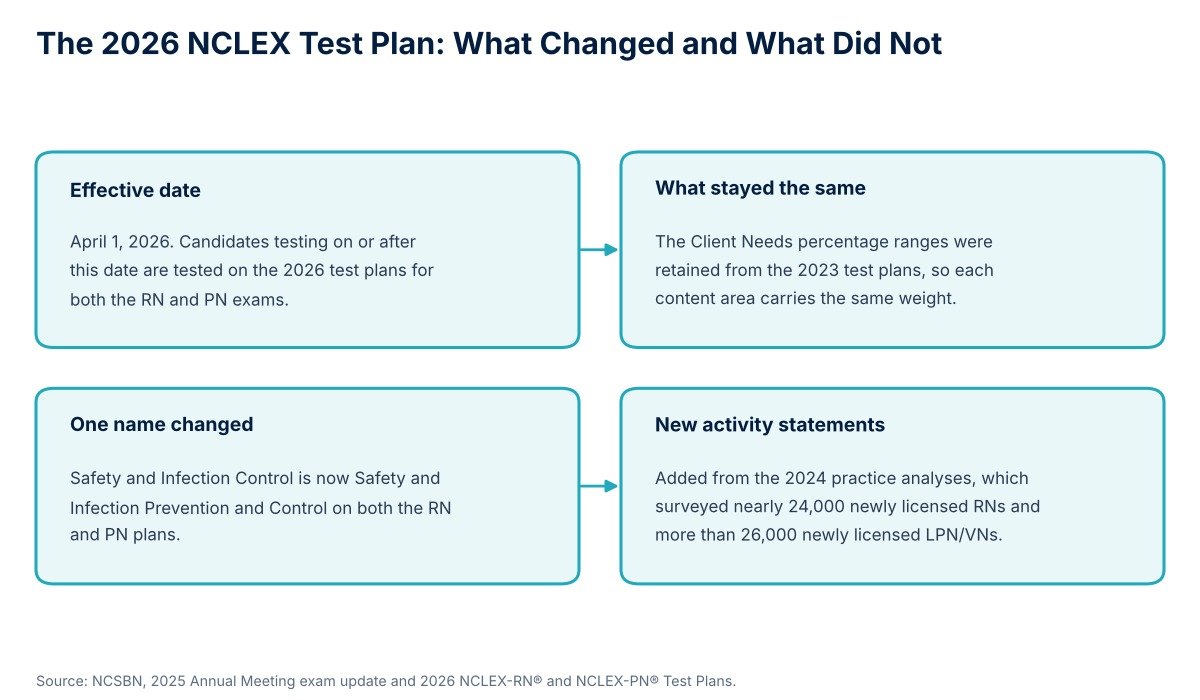
The renamed category is Safety and Infection Prevention and Control, which was Safety and Infection Control on the 2023 plan. NCSBN reviews its test plans every three years, so this version is the one to study from through the next review cycle. Material written for the 2023 plan is still useful for content, but it may not reflect the new activity statements, such as references to enhanced barrier precautions.
The NCLEX-RN® Test Plan, Category by Category
The sections that follow translate each content area into the kinds of decisions the exam asks nurses to make. The examples are drawn from the activity statements NCSBN publishes in the plan. NCSBN also posts sample items for every area on the official NCLEX website.
Management of Care (15 to 21%)
This is the largest single area. It covers delegating and supervising care, prioritizing clients by acuity, advocating for client rights, informed consent, advance directives, handoff report, referrals, documentation, mandatory reporting, ethical practice, and staying within the legal scope of practice. Questions typically ask who should do what, who should be seen first, and what must be reported.
Safety and Infection Prevention and Control (10 to 16%)
This area covers hand hygiene, aseptic and sterile technique, isolation, and standard and enhanced barrier precautions, along with injury prevention, restraint requirements, identifying clients correctly, allergies, handling hazardous materials, security plans, and reporting errors and near misses. Expect questions about the safest way to protect a client or a coworker in a specific situation.
Health Promotion and Maintenance (6 to 12%)
This area follows the lifespan, from prenatal and labor care through postpartum care, newborns, children, adolescents, adults, and older adults. It also includes health screening, preventive care, high-risk behaviors, readiness to learn, and assessing whether a client can manage care at home. The common thread is prevention and teaching.
Psychosocial Integrity (6 to 12%)
This area includes therapeutic communication, coping with illness and life changes, grief and loss, end-of-life care, abuse and neglect, substance misuse and withdrawal, violence risk, cultural practices, and care for clients with sensory or cognitive changes. Questions often reward the response that opens conversation and keeps the client safe.
Basic Care and Comfort (6 to 12%)
This area covers activities of daily living, nutrition and tube feedings, elimination, mobility, skin integrity, rest and sleep, intake and output, pain assessment, and nonpharmacological comfort measures. It also includes assistive devices and postmortem care. The questions are practical and focused on doing the fundamentals correctly.
Pharmacological and Parenteral Therapies (13 to 19%)
This area covers the rights of medication administration, dosage calculations, reviewing contraindications and laboratory results before giving a drug, IV therapy, blood products, central venous access devices, parenteral nutrition, controlled substances, high-risk medications, and client education about medications. It is the second largest area, so steady practice pays off.
Reduction of Risk Potential (9 to 15%)
This area focuses on preventing complications. It includes vital sign trends, focused assessments, laboratory and diagnostic results, preoperative and postoperative care, moderate sedation, specimen collection, and caring for tubes, catheters, and IV lines. The key skill is noticing a change early and acting on it.
Physiological Adaptation (11 to 17%)
This area covers acute, chronic, and life-threatening conditions. Examples include fluid and electrolyte imbalances, hemodynamics, ventilator and tracheostomy care, chest tubes and other drainage devices, wound care, ostomies, dialysis, telemetry, and emergency procedures. Expect questions that ask you to recognize complications and intervene.
Turning the Test Plan into a Study Map
The percentages tell you where the questions are, but your own results tell you where your points are at risk. The most efficient plan weighs both. A content area that is heavily tested and weak for you deserves the first hours, while a lightly tested area you already handle well needs only light review.
| Your results | How much the exam tests it | What to do |
|---|---|---|
| Weak | Heavily weighted | Study first and re-test within days |
| Weak | Lightly weighted | Schedule steady, shorter sessions |
| Strong | Heavily weighted | Maintain with mixed practice |
| Strong | Lightly weighted | Light review near the end |
Using the NCLEX-RN® Test Plan to Choose What to Study
Start by finding your starting point with a mixed set of questions, then sort what you missed into the eight areas above. PrepNurse.ai organizes practice by subject, such as pharmacology, pediatrics, and mental health, so it helps to note which content area each subject feeds. The step-by-step study schedule shows how to turn those results into weekly blocks.
Drilling one subject at a time works well once you know where the gaps are. The Subject Quiz mode is built for that, and you can see how it compares with the other quiz modes before you decide which to use.
Subject Quiz is a Premium mode, while the Question of the Day and the short quizzes stay free, so you may want to compare the free and Premium plans first.
Clinical Judgment and the Test Plan
Clinical judgment is measured alongside the eight content areas, not inside them. In the shortest exam, 18 questions come from three case studies, and about 10% of the remaining questions are stand-alone clinical judgment items. Those questions still draw on content from the areas above, but they score how well you recognize cues, analyze them, prioritize, and act. The Next Generation question formats are worth practicing before test day.
Practical nurse candidates use a separate test plan with its own percentages and a Coordinated Care area in place of Management of Care. The practical nurse exam overview walks through those differences.
For the overall exam format, time limit and scoring rules, the registered nurse exam overview is the place to start.
Every guide in the full set of NCLEX study resources builds on the same test plan, so you can move between them as your questions change.
If you are unsure how to apply the plan to your own timeline, you can talk with the support team.
NCLEX-RN® Test Plan Frequently Asked Questions
What is the NCLEX-RN test plan?
The NCLEX-RN test plan is NCSBN's blueprint for the exam. It lists the four Client Needs categories, the eight content areas and their percentage ranges, the integrated processes, and detailed lists of nursing activities that may be tested. It guides both exam development and candidate preparation.
When did the 2026 NCLEX-RN test plan take effect?
NCSBN's timeline put the 2026 NCLEX-RN and NCLEX-PN test plans, along with their passing standards, into effect on April 1, 2026. Candidates testing on or after that date are tested on the 2026 plan.
Did the percentages change in the 2026 test plan?
No. According to NCSBN, the Client Needs percentage ranges were retained from the previous plan. The changes were a revised name for one category, now Safety and Infection Prevention and Control, and new activity statements based on the 2024 practice analysis.
How often is the NCLEX test plan updated?
NCSBN reviews and approves the test plan every three years, using a practice analysis of newly licensed nurses and the judgment of the NCLEX Examination Committee. The passing standard is also reviewed every three years or after a test plan revision.
Does the test plan list the drugs and diseases I need to know?
No. NCSBN does not publish a list of medications that appear on the exam, and exams are not built around specific nursing specialties. The plan describes categories of nursing activity and the decisions an entry-level nurse makes, so studying concepts and safety reasoning is more reliable than memorizing lists.
What are the integrated processes on the NCLEX-RN?
They are six processes that appear throughout every content area: caring, clinical judgment, communication and documentation, culture and spirituality, the nursing process, and teaching and learning.
Start Practicing at Your Own Pace
Knowing the blueprint is only half of the work. The other half is practicing until the reasoning is automatic. PrepNurse.ai offers a free plan that needs no credit card, so you can answer your first questions, read the rationales, and see which content areas need the most attention.
PrepNurse.ai is an independent study resource and is not affiliated with or endorsed by NCSBN. NCLEX®, NCLEX-RN®, and NCLEX-PN® are registered trademarks of NCSBN. PrepNurse.ai is a study aid and does not guarantee an exam result.