
Nursing School Entrance Exam: Requirements and How to Prepare
A nursing school entrance exam is an admissions checkpoint: a standardized test that many programs ask applicants to complete so they can compare academic readiness fairly. It does not test nursing knowledge. It tests the reading, math, science, and writing skills you will rely on from the first semester. The rules around it, though, vary far more than most applicants expect. Programs choose the exam, set the minimum score, decide which attempt counts, and decide how long a result stays valid.
Exam details here come from ATI Testing, which publishes the TEAS, and from Elsevier's HESI A2 as documented in nursing program testing guides. Always treat your program's published requirements as the final word.

What a Nursing School Entrance Exam Measures
Entrance exams measure academic readiness, not clinical skill. They typically cover reading comprehension, mathematics, science with an emphasis on anatomy and physiology, and English or grammar. Programs use the results to screen applicants, to rank them when seats are limited, or to confirm that someone who meets every other requirement is ready for a demanding curriculum. Because seats are competitive, a score that merely clears the minimum may not be enough.
Which Entrance Exams Do Nursing Programs Use
Two exams are the most common. The TEAS is published by ATI and has four fixed sections, 170 questions, and 209 minutes. The HESI A2 is published by Elsevier and is modular, so each program chooses which sections its applicants take. Some programs use other assessments or their own exams, so never assume. The only reliable source is the program itself.
If your programs require the TEAS, the TEAS test guide covers every section and how it is scored.
If they require the HESI A2, the HESI A2 exam guide explains the section menu and the rules programs set.
If your programs differ, the TEAS and HESI comparison helps you decide where to start.
How Programs Use Your Entrance Exam Score
No single policy applies everywhere. Programs commonly set a minimum for the total or a composite score, and some also set a separate minimum for a section such as reading. Competitive programs often admit applicants well above the stated minimum, so the published number is a floor, not a target.
- Which attempt counts. Some programs use your highest score, some use your most recent score, and some use your first.
- How many attempts you get. Many programs allow only a set number of attempts per year, with a wait of about 30 days between them.
- How long a score stays valid. Programs commonly accept scores for one to two years.
- Whether sections must come from one sitting. Some programs require every section to be from the same test date.
Where to Find Your Nursing School Entrance Exam Requirements
Start with the nursing program's own admissions requirements and application packet, not a general website. If a detail is unclear, email the admissions office and ask for the answer in writing. Requirements can change between admission cycles, so confirm them again before you register, and check the nursing program, not only the college, because a school may set different rules for practical nursing and registered nursing applicants.
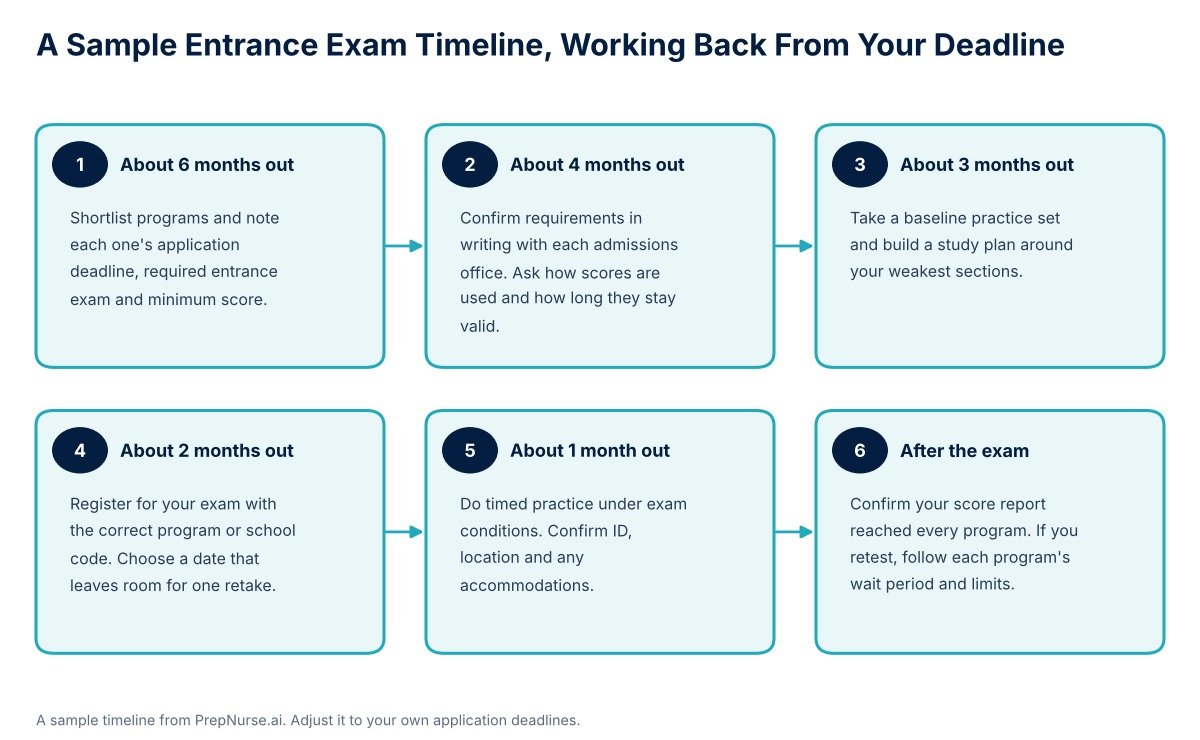
A Sample Entrance Exam Timeline
Working backward from your application deadline prevents the most common problem: discovering too late that your score will not arrive in time, or that you have no room for a retake. The timeline below is a sample, so compress or stretch it to fit your deadlines.
Your Nursing School Entrance Exam Checklist
- List every program you plan to apply to and its deadline.
- Record the required exam, sections, and minimum score for each program.
- Confirm how scores are used, how many attempts are allowed, and how long scores stay valid.
- Take a baseline practice set and note your score in each section.
- Register with the correct program or school code so scores reach every school.
- Leave room in your calendar for one retake before the deadline.
- After you test, confirm that every program received your score report.
How to Prepare for a Nursing School Entrance Exam
The preparation that works is the same for any of these exams: learn where you stand, work on the gaps, and rehearse under realistic conditions. Rereading a study guide feels productive, but the exams reward your ability to retrieve and apply information, so answering questions and reviewing the reasoning behind each one is more effective.
Study Habits That Work Across Entrance Exams
- Start with a baseline in every section your program requires.
- Work on the weakest required section first, especially if your program sets a separate minimum for it.
- Read explanations for every miss, and write down the rule you overlooked.
- Practice in short daily sessions instead of occasional marathons.
- Time yourself as the exam date approaches so pacing is not a surprise.
PrepNurse.ai includes a Nursing Entrance Exams program and a Nursing School program. The free plan has the Question of the Day plus Quick 10 and Quick 20 sets, and every question includes an explanation. You can browse the quiz modes to see which formats suit your schedule.
Timed practice is a Premium feature, and you can compare the free and Premium plans before deciding what you need.
Common Mistakes Applicants Make
- Studying for the wrong exam. Weeks of preparation are wasted if a program requires the other test.
- Waiting until the deadline. A late score, or a score that needs a retake, can cost an entire admission cycle.
- Ignoring section minimums. A strong total does not help if a required section falls below the program's floor.
- Registering without the program code. Scores that do not reach the right school can delay an application.
- Assuming the rules stay the same. Requirements can change from one cycle to the next.
If you need testing accommodations, start early. For the TEAS, ATI asks that accommodation requests be submitted at least 30 days before you test, and other publishers and programs have their own timelines. Contact each testing organization as soon as you know your exam date, and keep copies of every approval.
What Comes After the Entrance Exam
Passing the entrance exam is the first of several milestones. After nursing school comes the licensing exam, and later, for some nurses, advanced practice certification. The nursing exam preparation resources map out that whole path.
When licensure is next, the NCLEX study resources explain how the NCLEX-RN and NCLEX-PN work.
If you have questions about which exam or study path fits your applications, you can talk with the support team.
Nursing School Entrance Exam Frequently Asked Questions
What is on a nursing school entrance exam?
Most entrance exams cover reading comprehension, mathematics, science with an emphasis on anatomy and physiology, and English or grammar. The TEAS has four fixed sections, while the HESI A2 is modular and your program selects the sections you take.
Do all nursing programs require an entrance exam?
Not all of them. Many programs require the TEAS or the HESI A2, some use other assessments, and some rely on other admission criteria. The only reliable answer comes from the admissions requirements of each program you are considering.
What score do I need on a nursing school entrance exam?
There is no universal score. Each program sets its own minimum and may also require a minimum in a specific section. Competitive programs often admit applicants well above the minimum, so aim higher than the published floor.
How many times can I retake a nursing school entrance exam?
Retake policies come from the program and the test publisher. A wait of about 30 days between attempts is common, many programs limit attempts per year, and some use only your highest or most recent score. Confirm the rules before you register for a first attempt.
How early should I start preparing?
Start as soon as you have a target program and a deadline, and work backward. A baseline practice set shows how much preparation you need. Leaving room for a possible retake before your application deadline is one of the most useful planning steps.
Do all nursing schools use the same entrance exam?
No. Programs choose their own exam, and a few accept more than one. Scores from the TEAS and the HESI A2 do not substitute for each other, so confirm which exam each program requires before you study.
Start Practicing at Your Own Pace
Entrance exam prep works best when it is steady and honest about weak areas. PrepNurse.ai offers a free plan that needs no credit card, so you can start answering questions, read the explanations, and see where you stand.
PrepNurse.ai is an independent study resource and is not affiliated with or endorsed by ATI Testing or Elsevier. All trademarks belong to their respective owners. PrepNurse.ai is a study aid and does not guarantee an exam result or an admission decision.