
TEAS vs HESI A2: Which Exam Do You Need?
TEAS vs HESI is one of the first questions nursing applicants ask, and the honest answer is that you usually do not get to choose. Your program decides which entrance exam it requires, and a few accept either one. What you can control is how well you understand each exam, how you prepare for the one your programs expect, and how you avoid the costly mistake of studying for the wrong test. This comparison lays out the real differences so you can make that decision with confidence.
Facts about the TEAS come from ATI Testing, which publishes it, and facts about the HESI A2 come from Elsevier's design as documented in nursing program testing guides. Each program sets its own minimum scores and retake rules.

TEAS vs HESI: Key Differences
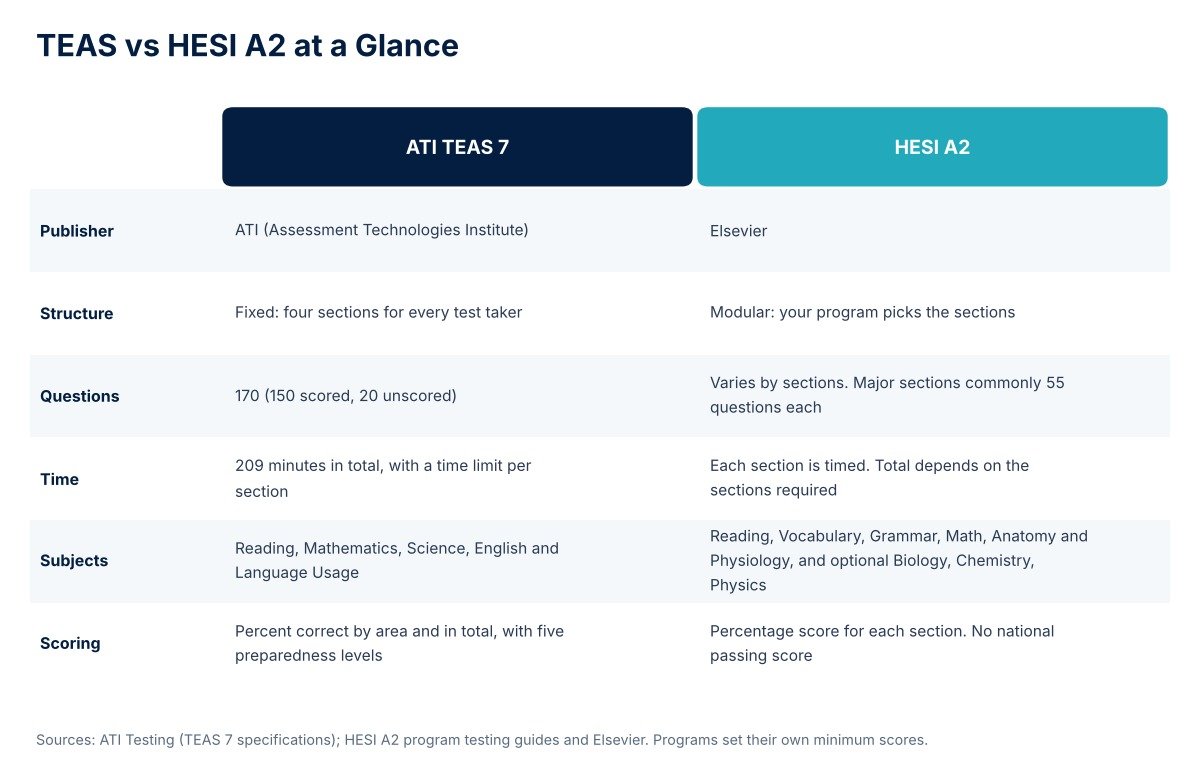
Both exams check whether applicants have the academic foundation for a nursing program, and both cover reading, math, science, and English in some form. The structure is where they diverge. The TEAS is one fixed exam, while the HESI A2 is a menu of sections that each program assembles for its own applicants.
Structure and Content
Every TEAS taker sees the same four sections in the same order: Reading, Mathematics, Science, and English and Language Usage. The exam has 170 questions, 150 of them scored, and the science section is the largest with 44 scored questions. A HESI A2 taker sees only the sections the program selected, such as reading comprehension, vocabulary, grammar, math, and anatomy and physiology, and a few programs add biology, chemistry, physics, or critical thinking.
Scoring
ATI reports an adjusted percent correct for each content area and the total, then places results into five preparedness levels. Elsevier reports a percentage for each HESI section, and many programs combine several of them into a composite. Neither exam has a universal passing score. Programs set the numbers, and some require a minimum in a specific section such as reading.
Time and Length
The TEAS gives you 209 minutes in total with a limit for each section. The HESI A2 times each section separately, and the total depends on how many sections your program requires. A program that asks for four sections is a shorter day than one that asks for six, so ask for the exact schedule.
Registration
You register for the TEAS through an ATI account, either at a testing center or online with a remote proctor. You register for the HESI A2 through Elsevier's Evolve site or through your program, using the code that sends scores to the right school. In both cases the program, not the publisher, controls retake limits and how long a score stays valid.
Is the TEAS or the HESI A2 Harder?
Difficulty is personal, and anyone who gives a flat answer is oversimplifying. The TEAS is a single, broad exam with a heavy science component, so applicants who are strong in anatomy, biology, and scientific reasoning often feel at home. The HESI A2 can be narrower, because your program may skip several sections, so applicants who are strong readers and writers may find a four-section version more manageable.
A better question is which exam asks you to show your strengths and which one exposes your gaps. Take a baseline in each format if you can, compare your scores by section, and let the results guide your plan. Spending time debating which exam is objectively harder is time not spent practicing.
How to Choose Between the TEAS and HESI A2
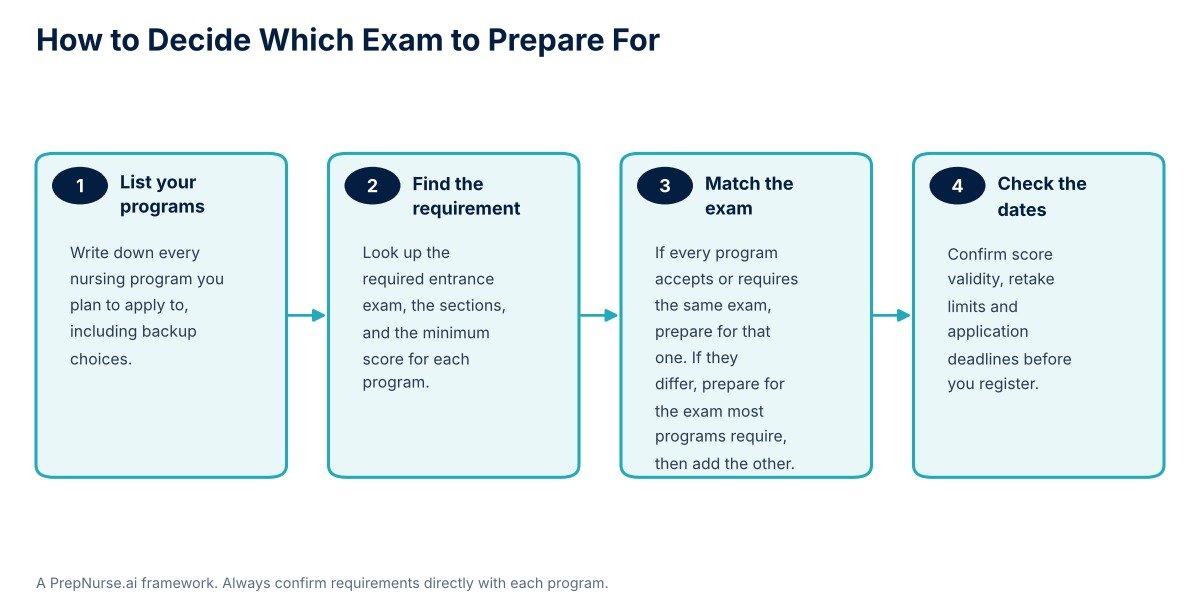
TEAS vs HESI: A Four-Step Decision
- List every program you plan to apply to, including your backup choices.
- Find the entrance exam, the required sections, and the minimum score for each program in its admissions requirements.
- Match the exam. If every program requires the same exam, prepare for that one. If they differ, prepare first for the exam most of your programs require, then add the other.
- Confirm dates and rules for score validity, retake limits, and application deadlines before you register.
Schools rarely accept one exam as a substitute for the other, and some publish different minimums for practical nursing and registered nursing programs. If a program's requirement is unclear, ask the admissions office to confirm it in writing before you pay for an exam.
Costs, Dates and Rules That Differ
Costs vary more than most applicants expect. The TEAS involves ATI's exam fee plus any proctoring or administration fee charged by the testing site, and the HESI A2 fee depends on your program and where you test. Neither number is fixed nationally, so compare the total you will actually pay. The same is true of retake rules and score validity, which each program sets for itself.
Questions to Ask Admissions Before You Register
- Which entrance exam do you require, and do you accept the other one?
- Which sections and which minimum scores do you require?
- How is the score used: highest attempt, most recent attempt, or first attempt?
- How many attempts are allowed per year, and how long must I wait between them?
- How long is a score valid, and what is the application deadline?
Get the answers in writing if you can, and keep them with your application notes. Requirements can change from one admissions cycle to the next, so the answer you received last year may not still apply.
Preparing for Both Without Doubling Your Work
The two exams draw on the same foundation, including reading comprehension, grammar and language, math, and anatomy and physiology. Skills you build for one transfer to the other, so your study time is rarely wasted if your plans change. The formats and question counts are different, so once your content is solid, practice in the format of the exam you will actually sit for.
Build the plan around your weakest sections first. A baseline will show whether your biggest gap is science, math, reading, or writing, and a short daily session with explanations is more useful than an occasional long one. PrepNurse.ai includes a Nursing Entrance Exams program, and you can explore every quiz mode to find a format that fits your day.
The free plan includes the Question of the Day plus Quick 10 and Quick 20 sets. Timed practice is a Premium feature, and you can compare the free and Premium plans before deciding what you need.
For a closer look at each exam, read the TEAS test guide.
The HESI A2 exam guide explains the section menu in more detail.
If you want to see how the exam fits into the whole application, read the entrance exam application guide.
The nursing exam preparation resources show the path from admission through licensure and advanced practice.
If you want help choosing a study path, you can reach out through the support team at any time.
TEAS vs HESI A2 Frequently Asked Questions
Which is harder, the TEAS or the HESI A2?
Neither is objectively harder. The TEAS is one broad exam with a large science component, while the HESI A2 depends on which sections your program requires. Compare your baseline scores by section in each format, and let your own strengths and gaps guide your preparation.
Can I choose between the TEAS and the HESI A2?
Usually not. Your program decides which exam it requires, and a few accept either. Check the admissions requirements for every program you are considering before you register for an exam.
Do nursing schools accept scores from either exam?
Rarely. Most programs name one exam, and scores from one exam do not substitute for the other. If a program accepts either, it may still set different minimum scores for each, so confirm the details with the admissions office.
What is the main difference between the TEAS and HESI A2?
The TEAS is published by ATI and has four fixed sections, 170 questions, and 209 minutes. The HESI A2 is published by Elsevier and is modular, so your program chooses the sections, and the length depends on that selection.
Will studying for one exam help me with the other?
Yes, to a large degree. Both draw on reading, math, language, and anatomy and physiology, so your foundation transfers. The formats differ, so practice in the format of the exam you will actually take.
Is there a passing score for the TEAS or HESI A2?
Neither exam has a universal passing score. ATI reports percent correct and a preparedness level for the TEAS, and Elsevier reports a percentage for each HESI section. Each program sets the minimum it requires.
Start Practicing at Your Own Pace
Whichever exam your program requires, the preparation looks the same: practice, review the reasoning, and focus on weak areas. PrepNurse.ai offers a free plan that needs no credit card, so you can start answering questions and see where you stand.
PrepNurse.ai is an independent study resource and is not affiliated with or endorsed by ATI Testing or Elsevier. All trademarks belong to their respective owners. PrepNurse.ai is a study aid and does not guarantee an exam result or an admission decision.