
TEAS Test: Format, Scoring and How to Prepare
The TEAS test, short for Test of Essential Academic Skills, is the entrance exam many nursing programs use to check whether applicants are academically ready. It is published by ATI, and the current version is the ATI TEAS 7. The exam is not about nursing knowledge. It measures reading, math, science, and English skills, and it is scored so that programs can compare applicants. Knowing exactly how it is built makes it far easier to decide how to spend your study time.
The exam specifications here come from ATI Testing, which publishes the TEAS. Programs set their own rules for minimum scores, retakes, and how long a score stays valid, so always confirm those with each program you are applying to.

How the TEAS Test Is Structured
The ATI TEAS 7 has 170 questions and a total time limit of 209 minutes. Of the 170 questions, 150 are scored and 20 are unscored pretest items that ATI uses to develop future versions. You cannot tell which are which, so every question deserves your full attention. The four sections are taken in a fixed order, and each has its own time limit.
| Section | Questions | Scored | Time limit |
|---|---|---|---|
| Reading | 45 | 39 | 55 minutes |
| Mathematics | 38 | 34 | 57 minutes |
| Science | 50 | 44 | 60 minutes |
| English and Language Usage | 37 | 33 | 37 minutes |
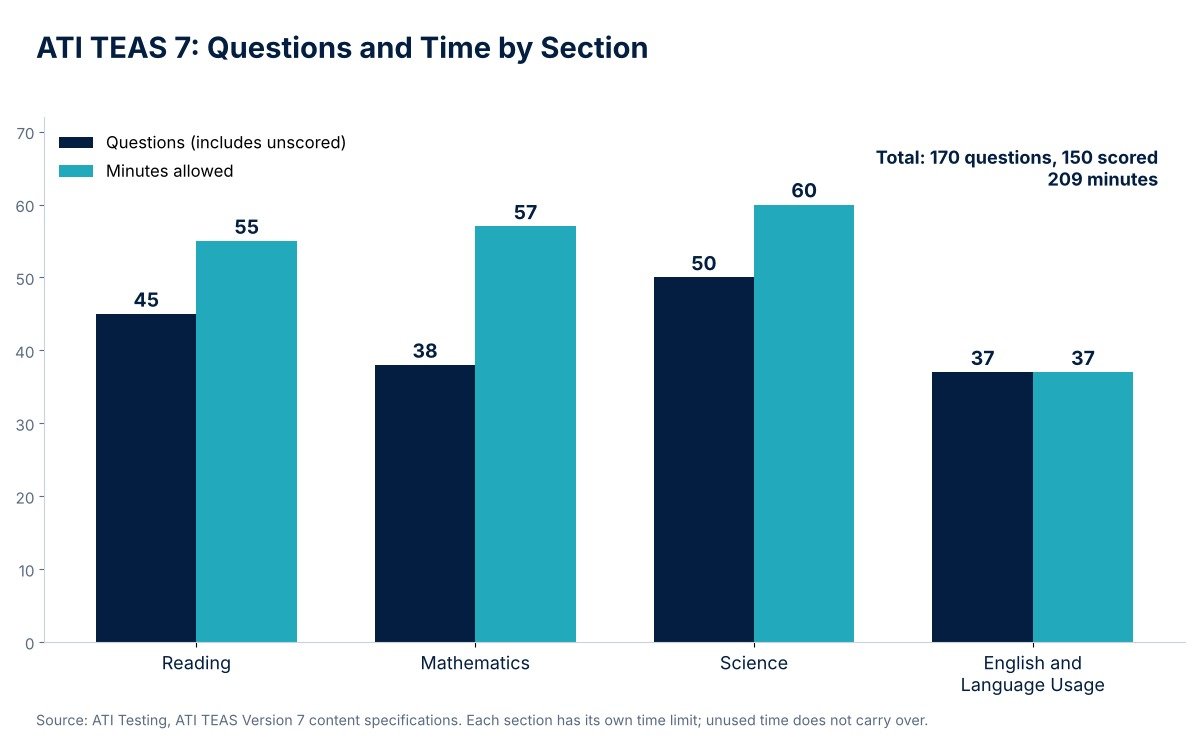
Question types include multiple choice, multiple select, fill in the blank, ordered response, and hot spot. ATI describes the pacing as roughly 1.2 minutes per question in Reading, 1.5 in Mathematics, 1.2 in Science, and 1 in English and Language Usage. Unused time in one section does not carry over to the next. You can take the exam at a testing center or online with a remote proctor, depending on what your program accepts.
What the TEAS Test Covers
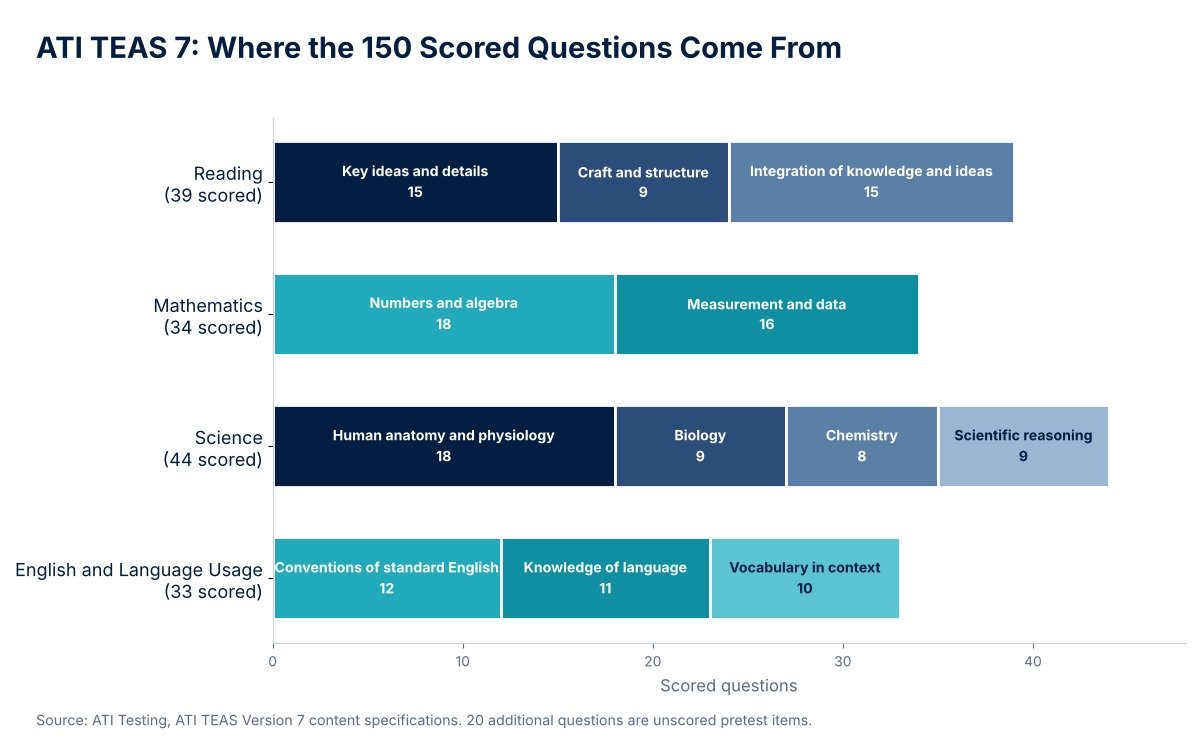
Each section breaks into content areas with a fixed number of scored questions. The science section has the most scored questions, which makes it the largest single opportunity for most applicants.
Reading (39 scored questions)
Reading questions fall into key ideas and details (15), craft and structure (9), and integration of knowledge and ideas (15). That means finding the main idea, supporting evidence, and conclusions, understanding an author's purpose and word choices, and comparing information across sources, charts, or arguments.
Mathematics (34 scored questions)
Mathematics is split between numbers and algebra (18) and measurement and data (16). Expect fractions, decimals, percentages, ratios, equations, unit conversions, and reading tables and graphs. These are practical skills that also support medication calculations later in nursing school.
Science (44 scored questions)
Science includes human anatomy and physiology (18), biology (9), chemistry (8), and scientific reasoning (9). Anatomy and physiology carries the most weight, so understanding how body systems work together matters more than memorizing isolated terms. Scientific reasoning asks you to interpret data and experimental designs.
English and Language Usage (33 scored questions)
This section covers conventions of standard English (12), knowledge of language (11), and using language and vocabulary to express ideas in writing (10). Think grammar, punctuation, sentence structure, word choice, and clear writing. It is the shortest section, but its points count the same as any other.
TEAS Scoring and What Counts as a Good Score
The TEAS is not a pass or fail exam. ATI reports an adjusted percent correct for each content area and for the exam as a whole, and places results into five preparedness levels: developmental, basic, proficient, advanced, and exemplary. You can see your score report as soon as you finish.
What counts as a competitive score depends entirely on the program. Some set a minimum for the total score, some also set a separate minimum for a section such as Reading, and competitive programs often admit applicants well above their stated minimum. Programs also differ on which attempt counts, since some use the highest score and others use the most recent one. Ask each admissions office to explain exactly how it uses your result.
Test Day and Pacing Tips
Most points on test day are lost to avoidable problems, not to missing knowledge. A few habits protect your score.
- Know the rules of your testing site. If you test online, log in early. Depending on the site, arriving late can mean rescheduling and paying again.
- Bring identification that matches your registration. A name mismatch can end your appointment before it starts.
- Use every minute in each section. Unused time does not carry over, so spend any leftover time checking your work.
- Read the whole question. Multiple select and ordered response questions need every part of the prompt.
- Move steadily. If one question is taking far longer than the pacing guide, make your best choice and keep the rest of the section on schedule.
Science and Mathematics often feel the most time pressured, because their time per question is longer but their questions are denser. Practicing those sections with a timer is usually the best way to find out whether pacing, not content, is what is costing you points.
Registering and Retaking the TEAS
You register through an ATI account, then choose a testing center or the online proctored option and a date. ATI's exam fee is separate from any proctoring or administration fee charged by the testing site, so the total varies. Check the current details on ATI's registration information before you pay.
Most programs require at least 30 days between attempts, and many limit how many attempts you can make in a year. Programs also decide how long a score stays valid, commonly one to two years. Because these rules differ, a retake plan belongs in your timeline from the start, not after a disappointing result.
How to Study for the TEAS Test
Rereading a study guide feels productive, but the exam rewards retrieval under time pressure. The most reliable approach is to answer questions, check the explanation for each one, and return to the topics you missed.
Study Habits for the TEAS Test
- Start with a baseline. Take a mixed set across all four sections and record your score in each.
- Weight your time. Science carries 44 scored questions and Reading 39, so weak areas there cost the most.
- Practice active recall. Answer first, then read the rationale, and write down the rule you missed.
- Use the pacing guide. Time yourself at about one to one and a half minutes per question.
- Rehearse under exam conditions. Sit for full sections without interruptions before test day.
PrepNurse.ai includes a Nursing Entrance Exams program for applicants. The free plan has the Question of the Day plus Quick 10 and Quick 20 sets, and every question comes with an explanation. You can browse the quiz modes to find a format that fits your schedule.
Timed practice is a Premium feature. You can compare the free and Premium plans and start on the free plan without a credit card.
If Your Program Requires a Different Exam
Some programs require the HESI A2 instead of the TEAS, and some accept either. The HESI A2 exam guide explains how that exam is built.
If you are not sure which exam to prepare for, the TEAS and HESI comparison lays out the differences side by side.
For the application process as a whole, including timelines and what to ask admissions offices, read the entrance exam application guide.
The full set of nursing exam preparation resources shows where the TEAS fits in the path from admission to licensure.
If you would like help choosing a study path, you can talk with the support team.
TEAS Test Frequently Asked Questions
How many questions are on the TEAS test?
The ATI TEAS 7 has 170 questions: 45 in Reading, 38 in Mathematics, 50 in Science, and 37 in English and Language Usage. Of those, 150 are scored and 20 are unscored pretest items. The total time limit is 209 minutes, with a separate limit for each section.
Is the TEAS test pass or fail?
No. ATI reports an adjusted percent correct for each content area and for the total, and assigns one of five preparedness levels. Each nursing program decides what score it requires and how it uses the result in admissions.
How long should I study for the TEAS test?
There is no standard length. Take a baseline practice set, see which sections are weakest, and build your plan from your results and your application deadline. Weak areas in Science and Reading deserve extra time because they carry the most scored questions.
How many times can I take the TEAS test?
Most programs require at least 30 days between attempts, and many limit how many attempts count each year. Some use your highest score and others use your most recent score, so confirm the policy with every program you are applying to.
How much does the TEAS test cost?
The total depends on where you test. ATI charges an exam fee, and the testing site may add its own proctoring or administration fee. Check ATI's registration information and your program's testing guidelines for the current amounts before you register.
Is the TEAS test the same for LPN and RN programs?
ATI publishes one TEAS, but each program sets its own minimum scores, and requirements can differ between practical nursing and registered nursing programs at the same school. Always confirm the score your specific program expects.
Start Practicing at Your Own Pace
Entrance exam prep works best when it is steady and honest about weak areas. PrepNurse.ai offers a free plan that needs no credit card, so you can start answering questions, read the explanations, and see where you stand.
PrepNurse.ai is an independent study resource and is not affiliated with or endorsed by ATI Testing, which publishes the TEAS. All trademarks belong to their respective owners. PrepNurse.ai is a study aid and does not guarantee an exam result or an admission decision.