
NCLEX-RN® Exam: What to Expect and How to Prepare
The NCLEX-RN® is the licensing exam that graduates of registered nursing programs take so a board of nursing can decide whether they are ready to practice safely as an entry-level registered nurse. Most candidates arrive having studied hard, yet many still feel unsure what the exam really asks of them. The short answer is that it asks less about recalling isolated facts and more about recognizing what matters in a clinical situation, deciding what comes first, and acting safely. Knowing how the exam is built gives you a clear target before you choose a single study resource.
Every number here comes from the National Council of State Boards of Nursing (NCSBN), the organization that develops the exam, and reflects the 2026 NCLEX-RN® Test Plan that took effect in April 2026.
How the NCLEX-RN® Exam Works
The exam uses computerized adaptive testing. Instead of giving every candidate the same set of questions, the computer builds a unique exam as you go. After each answer it re-estimates your ability, then selects the next question from a large pool. It chooses an item you are expected to find challenging, while keeping the exam in line with the content percentages in the test plan. Because the exam is designed to feel challenging for everyone, difficulty alone is not a reliable signal of how you are doing.
Exam Length and Time Limit
Every RN candidate answers at least 85 questions, and no one answers more than 150. The five-hour limit includes all breaks. The table shows what makes up the shortest possible exam.
| Exam detail | What NCSBN specifies |
|---|---|
| Minimum number of questions | 85 |
| Maximum number of questions | 150 |
| Time limit | Five hours, including all breaks |
| Scored content questions in the minimum exam | 52, drawn from the eight content areas |
| Clinical judgment case study questions | 18 (three case studies of six questions each) |
| Unscored pretest questions | 15 on every exam |
Pretest questions look and read exactly like scored questions, so there is no way to tell them apart during the exam. The practical takeaway is simple: give every question your full attention. There is also no time limit on any single question, and once you confirm an answer and move on, you cannot go back to it.
How the Exam Decides Whether You Passed
The computer stops the exam under one of three rules.
- The 95% confidence rule: After you reach the minimum number of questions, the exam ends as soon as the computer is 95% certain your ability is clearly above or clearly below the passing standard. This is the most common way the exam ends.
- Maximum-length exam: If your ability is very close to the passing standard, the exam continues to 150 questions. The computer then looks only at your final ability estimate.
- Run-out-of-time rule: If time expires before you reach the maximum, the result depends on whether you completed the minimum number of questions and on your final ability estimate.
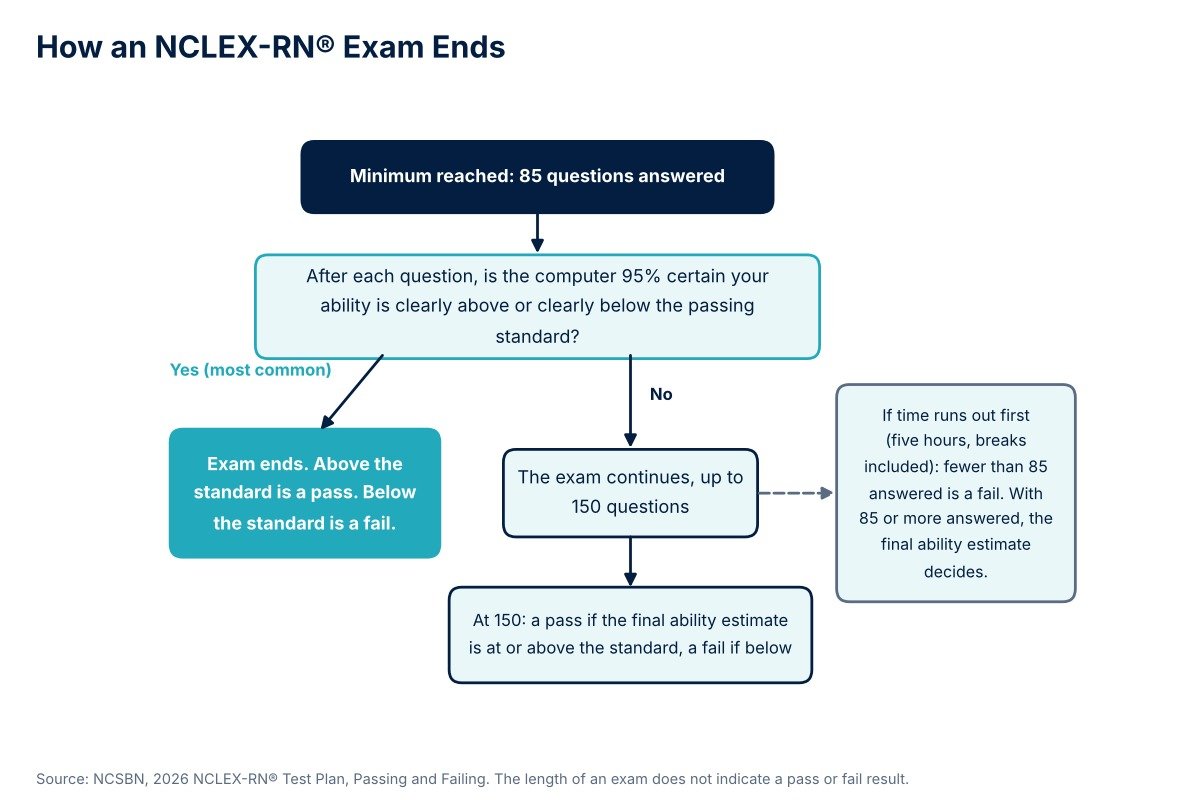
NCSBN states plainly that the length of your exam is not an indication of whether you passed or failed. A candidate can pass or fail at any length, so it helps to resist the urge to count questions and simply answer the one in front of you.
What the 2026 Test Plan Covers
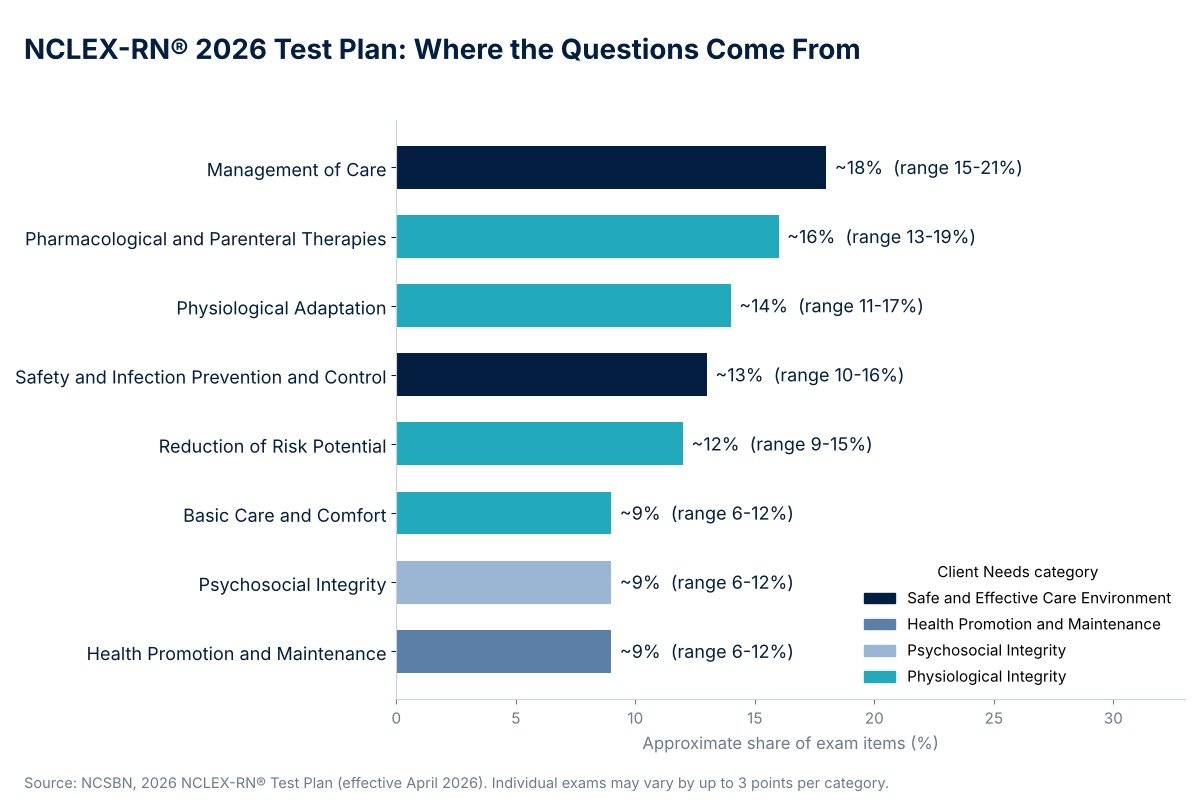
The exam is organized around four Client Needs categories, and two of them are divided into subcategories, which gives eight content areas in total. Each area carries a percentage range, and the computer makes sure your exam stays within those ranges. Because exam length varies, an individual exam can differ from the ranges by up to three percentage points in each area.
| Content area | Share of items | What to practice (examples from NCSBN) |
|---|---|---|
| Management of Care | 15 to 21% | Delegation and supervision, prioritizing by acuity, advocacy, informed consent, handoff report |
| Safety and Infection Prevention and Control | 10 to 16% | Standard and enhanced barrier precautions, restraints, error reporting, client identification, allergies |
| Health Promotion and Maintenance | 6 to 12% | Growth and development, prenatal and postpartum care, screening, preventive care education |
| Psychosocial Integrity | 6 to 12% | Therapeutic communication, grief, substance misuse, abuse and neglect, end-of-life care |
| Basic Care and Comfort | 6 to 12% | Nutrition, elimination, mobility, skin integrity, nonpharmacological comfort measures |
| Pharmacological and Parenteral Therapies | 13 to 19% | Rights of medication administration, dosage calculations, IV therapy, blood products, high-risk medications |
| Reduction of Risk Potential | 9 to 15% | Vital sign trends, laboratory values, diagnostic tests, pre- and postoperative care, tubes and lines |
| Physiological Adaptation | 11 to 17% | Fluid and electrolyte imbalances, ventilator care, drainage devices, hemodynamics, emergencies |
The four Physiological Integrity subcategories (Basic Care and Comfort, Pharmacological and Parenteral Therapies, Reduction of Risk Potential, and Physiological Adaptation) add up to roughly half of all items. Management of Care and Pharmacological and Parenteral Therapies are the two largest single areas, so they deserve steady attention without crowding out the smaller categories, which still count toward the same pass or fail decision.
NCSBN reviews the test plan every three years, using a practice analysis in which nearly 24,000 newly licensed RNs described the care they actually deliver. The 2026 plan is based on the 2024 analysis. According to NCSBN, the Client Needs percentage ranges were retained from the previous plan, one subcategory was renamed (it is now Safety and Infection Prevention and Control), and new activity statements were added. If you want a closer look at each area, the category-by-category blueprint breakdown explains how to study for each one.
Clinical Judgment Case Studies and Next Generation Item Types
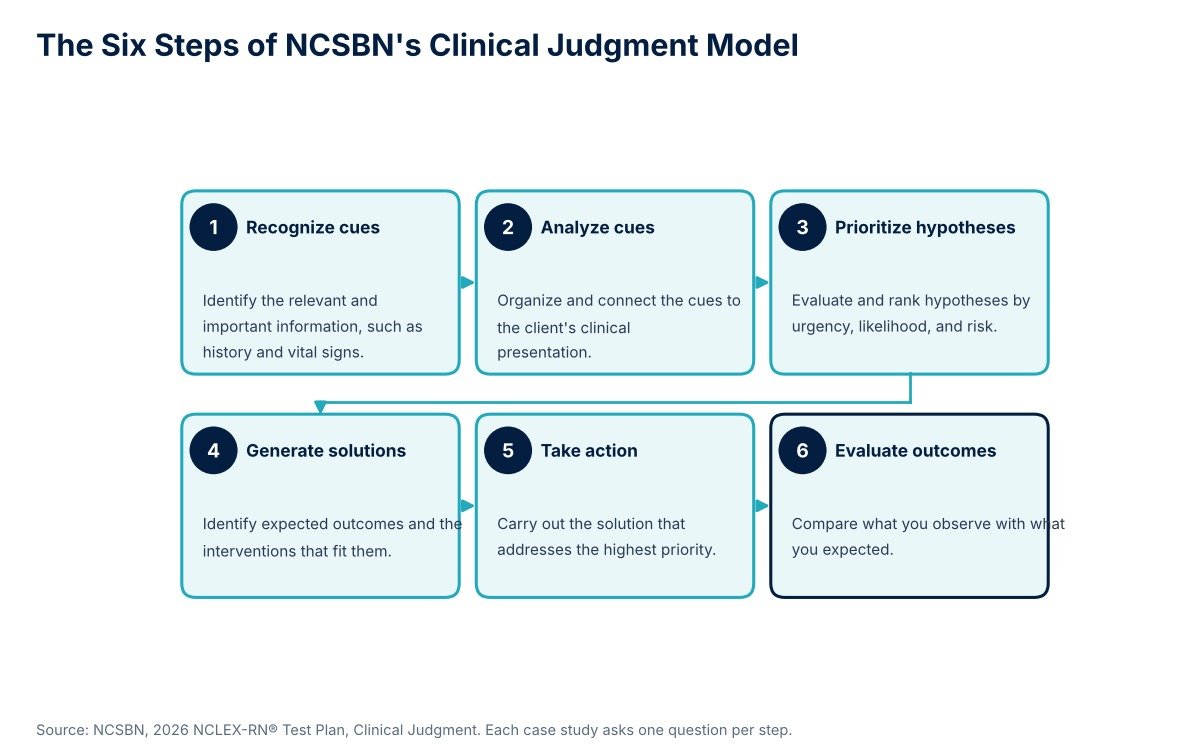
Clinical judgment is measured directly. Each exam includes three case studies, and each case study follows one client through six connected questions as new information unfolds. The six questions line up with the steps of the NCSBN Clinical Judgment Measurement Model:
- Recognize cues: identify the relevant information, such as history and vital signs.
- Analyze cues: connect that information to the client's presentation.
- Prioritize hypotheses: weigh urgency, likelihood, and risk.
- Generate solutions: define the interventions that fit the expected outcomes.
- Take action: carry out the solution that addresses the highest priority.
- Evaluate outcomes: compare what you observe with what you expected.
About 10% of the questions are stand-alone clinical judgment items, such as bow-tie and trend questions. Since April 2023, the exam has also used several interactive formats alongside traditional multiple choice, including extended multiple response, matrix or grid, drag and drop, drop-down, and highlight questions. Practicing these Next Generation item formats before test day means the screen layout never costs you time or confidence.
A Study Approach That Builds Clinical Judgment
Rereading notes feels productive because the material looks familiar, but the exam asks you to retrieve and apply knowledge, not recognize it. Answering questions from memory and then studying why each option is right or wrong is one of the best-supported ways to learn, and it matches what the exam measures. The licensure exam preparation resources at PrepNurse.ai are built around that idea.
Find Your Baseline, Then Study by Weakness
Start with a mixed set of questions across the Client Needs categories to see where you actually stand, not where you feel you stand. Candidates often over-study the subjects they enjoy and avoid the ones that unsettle them. Once you know your weakest areas, put your hours there first and revisit strong areas on a lighter schedule. A written adaptive study schedule built around your weak areas keeps that decision from being made fresh every morning.
Read Every Rationale, Including for Questions You Got Right
A correct answer reached for the wrong reason is a hidden gap. After every question, read the full rationale and ask three things: why is the right option the safest or highest priority, why does each wrong option fail, and what cue in the scenario should have pointed you there? That habit is what turns practice volume into clinical reasoning. Every question on PrepNurse.ai comes with a rationale for this reason.
Practice Habits for the NCLEX-RN® Format
Short, consistent sessions work well alongside a busy clinical or work schedule. The free plan includes the Question of the Day plus Quick 10 and Quick 20 sets, which are easy to fit between obligations. Premium adds longer and more exam-like formats, including Timed Quiz and AI Quiz. Rotating through the available quiz modes builds both knowledge and the stamina to stay focused across a long, adaptive exam.
Rehearse Prioritizing with Clinical Simulations
Prioritization is the skill most candidates say feels hardest to practice from a book. Scenario-based games such as the Emergency Room Challenge, Infection Control Simulator, and Drug Match Challenge put you in a situation where you must choose what to do first and see the consequence. These clinical decision games turn prioritization into something you can repeat until the reasoning becomes automatic.
The simulations are a Premium feature, while the Question of the Day and short quizzes stay free. You can compare the free and Premium plans before deciding what fits your timeline and budget.
Registration, Retesting, and the RN or PN Question
To sit for the exam, you register with Pearson VUE and apply to your state or territorial board of nursing, which determines your eligibility. The Pearson VUE registration fee for U.S. licensure is currently $200, and your board may charge its own licensure fee on top of that. NCSBN has announced that registrations completed on or after February 1, 2027 will cost $350, and the date you register, not the date you test, decides which fee applies. Fees and rules can change, so confirm the current details on the official NCLEX website before you pay.
If you do not pass, NCSBN requires 45 test-free days between attempts and allows up to eight attempts per year, although a jurisdiction can set stricter rules. That means a result you did not want is a reason to adjust your plan, not the end of the road.
Candidates finishing a practical or vocational program take a different exam. The practical nurse licensure exam uses the same four Client Needs categories and the same 85 to 150 question format, but it has its own test plan and different percentages. Studying from material written for the wrong license level is a common and avoidable mistake.
If you are unsure which exam applies to you or which study path fits your timeline, you can talk with the support team before you start.
NCLEX-RN® Exam Frequently Asked Questions
How many questions are on the NCLEX-RN®?
Every candidate answers at least 85 questions and no more than 150, within a five-hour limit that includes breaks. Of the 85 questions in the shortest exam, 52 are scored content questions, 18 belong to three clinical judgment case studies, and 15 are unscored pretest questions.
Does finishing at 85 questions mean I passed?
No. NCSBN states that the length of your exam is not an indication of a pass or fail result. A candidate can pass or fail whether the exam ends at 85 questions, 150 questions, or anywhere in between.
What is the 95% confidence rule?
After you answer the minimum number of questions, the computer ends the exam once it is 95% certain that your ability is clearly above or clearly below the passing standard. This is the most common way the exam ends. If your ability is very close to the standard, the exam continues until the maximum number of questions.
What changed in the 2026 NCLEX-RN® test plan?
The 2026 test plan took effect in April 2026 and is based on NCSBN's 2024 RN practice analysis. According to NCSBN, the Client Needs percentage ranges were retained from the prior plan, the Safety and Infection Control subcategory was renamed Safety and Infection Prevention and Control, and new activity statements were added. NCSBN reviews the test plan every three years.
How much does the NCLEX-RN® cost, and is the fee changing?
The registration fee for U.S. licensure is currently $200 and is paid to Pearson VUE, separate from any fee your board of nursing charges. NCSBN has announced that the fee will be $350 for registrations completed on or after February 1, 2027. The registration date, not the exam date, determines the fee, retakes carry the same fee, and registration fees are not refundable.
How soon can I retake the NCLEX-RN® if I do not pass?
NCSBN policy requires 45 test-free days between attempts and allows up to eight attempts per year. Your state or territorial board of nursing can set stricter limits, so check with your board before planning a retake date. You must register with Pearson VUE again and pay the registration fee for each attempt.
What is the difference between the NCLEX-RN® and the NCLEX-PN®?
Both exams use the same four Client Needs categories, adaptive testing, and an 85 to 150 question range. They have separate test plans written for different scopes of practice. For example, the RN plan includes Management of Care, while the PN plan includes Coordinated Care, and the percentages for each content area differ.
Start Practicing at Your Own Pace
Preparation works best when it is steady, honest about weak areas, and focused on understanding why answers are right. PrepNurse.ai offers a free plan that needs no credit card, so you can answer your first questions, read the rationales, and see where you stand today.
PrepNurse.ai is an independent study resource and is not affiliated with or endorsed by NCSBN. NCLEX®, NCLEX-RN®, and NCLEX-PN® are registered trademarks of NCSBN. PrepNurse.ai is a study aid and does not guarantee an exam result.