
Next Gen NCLEX® (NGN): Question Types and Clinical Judgment
The NGN NCLEX, short for Next Generation NCLEX®, is the current design of the nursing licensing exam. Since April 2023 it has measured clinical judgment directly, using case studies and interactive question formats alongside traditional multiple choice. The content areas are the same ones candidates already know. What changed is how the exam asks you to show your reasoning, and unfamiliar screens are the part most candidates can fix with practice.
Descriptions of the formats here come from NCSBN's own Next Generation NCLEX® publications and from the 2026 NCLEX-RN® and NCLEX-PN® Test Plans. The Next Generation design applies to both exams.

What the NGN NCLEX Measures
NCSBN describes clinical judgment as an iterative, multistep process. A nurse uses nursing knowledge to observe and assess a situation, identify the client concern that matters most, and arrive at the best evidence-based solution for safe care. The exam breaks that process into six steps, and each case study asks one question per step. The table shows each step with an illustration of the thinking involved.
| Step | The question you are answering | Illustration for a postoperative client |
|---|---|---|
| 1. Recognize cues | Which findings matter? | New confusion, a rising heart rate, and a falling oxygen saturation |
| 2. Analyze cues | What do these findings mean together? | The pattern points toward reduced oxygenation, not routine fatigue |
| 3. Prioritize hypotheses | Which explanation is most urgent or most likely? | Poor oxygenation outranks pain or anxiety as the first concern |
| 4. Generate solutions | What outcome do I want, and what could achieve it? | Restore oxygenation, find the cause, and involve the provider |
| 5. Take action | Which solution addresses the highest priority? | Raise the head of the bed, apply oxygen as ordered, and notify the provider |
| 6. Evaluate outcomes | Did it work? | Oxygen saturation and mental status improve, or care escalates |
The illustration is written to show the thinking process. It is not an exam question.
The emphasis on clinical judgment is not arbitrary. NCSBN builds each test plan from a practice analysis of newly licensed nurses, and the 2024 analyses, which surveyed nearly 24,000 newly licensed RNs and more than 26,000 newly licensed LPN/VNs, found clinical judgment to be highly relevant and important to safe, effective care at the entry level. Entry-level nurses are expected to make increasingly complex decisions, so the exam tests the decision process itself and not only the facts behind it.
Case Studies and Stand-Alone Items
Clinical judgment is measured in two ways. A case study follows one client through six connected questions as new information unfolds, and the exam does not adapt while you are inside a case. Stand-alone clinical judgment items are single questions that combine some or all of the six steps. In the shortest exam, the 18 case study questions sit alongside 52 scored content questions and 15 unscored pretest questions, and the full blueprint by Client Needs category shows how all of it fits together.
| Type | Size | Steps it addresses |
|---|---|---|
| Case study | Six connected questions | All six steps, in sequence, as the client's situation changes |
| Bow-tie | One question | All six steps combined in a single item |
| Trend | One question | One or more of the six steps, using client data over time |
Bow-tie Questions
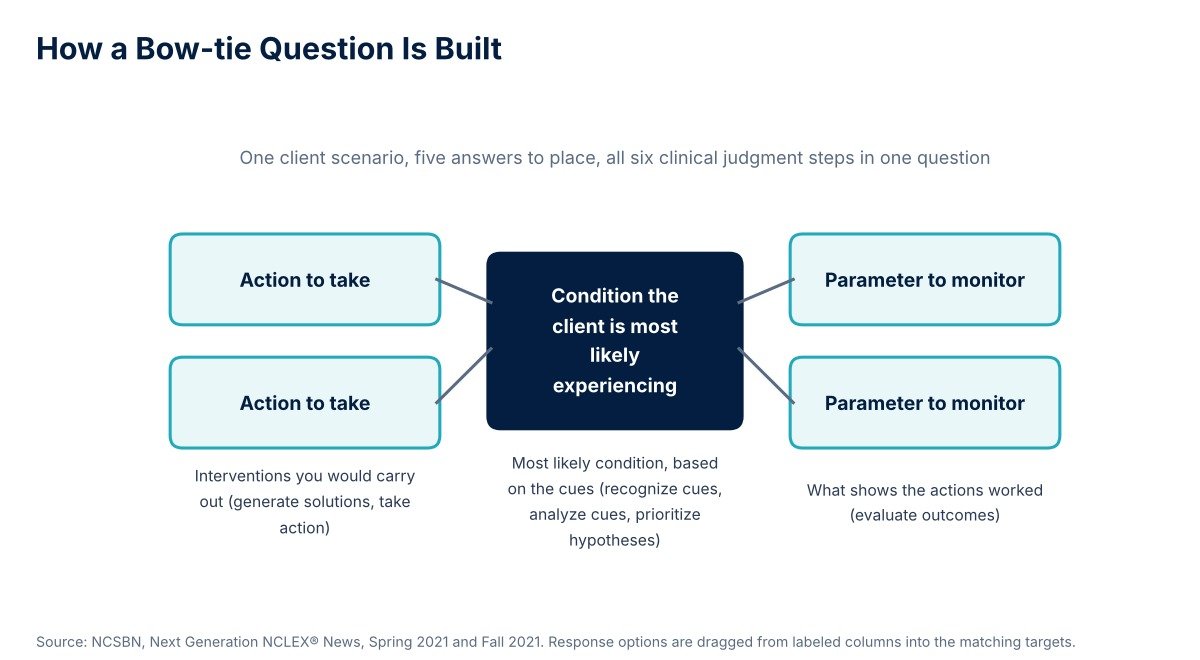
A bow-tie question presents a client scenario with tabs of information, such as nurses' notes, history, vital signs, and laboratory results. You then fill five targets by dragging response options from labeled columns: the condition the client is most likely experiencing, two actions to take, and two parameters to monitor. Every target must be filled before you can move on. The response area is shaped like a bow-tie, which is where the name comes from.
Trend Questions
A trend question gives you client information that changes over time, again organized in tabs such as vital signs, laboratory results, and medications. Unlike a bow-tie question, a trend question addresses one or more of the six steps rather than all of them, and it can use any of the new response formats except the bow-tie. The skill being tested is noticing what the data are doing, not recalling a single value in isolation.
The Interactive Item Formats
Beyond case studies and stand-alone items, the exam uses several response formats that look different from a standard multiple choice question.
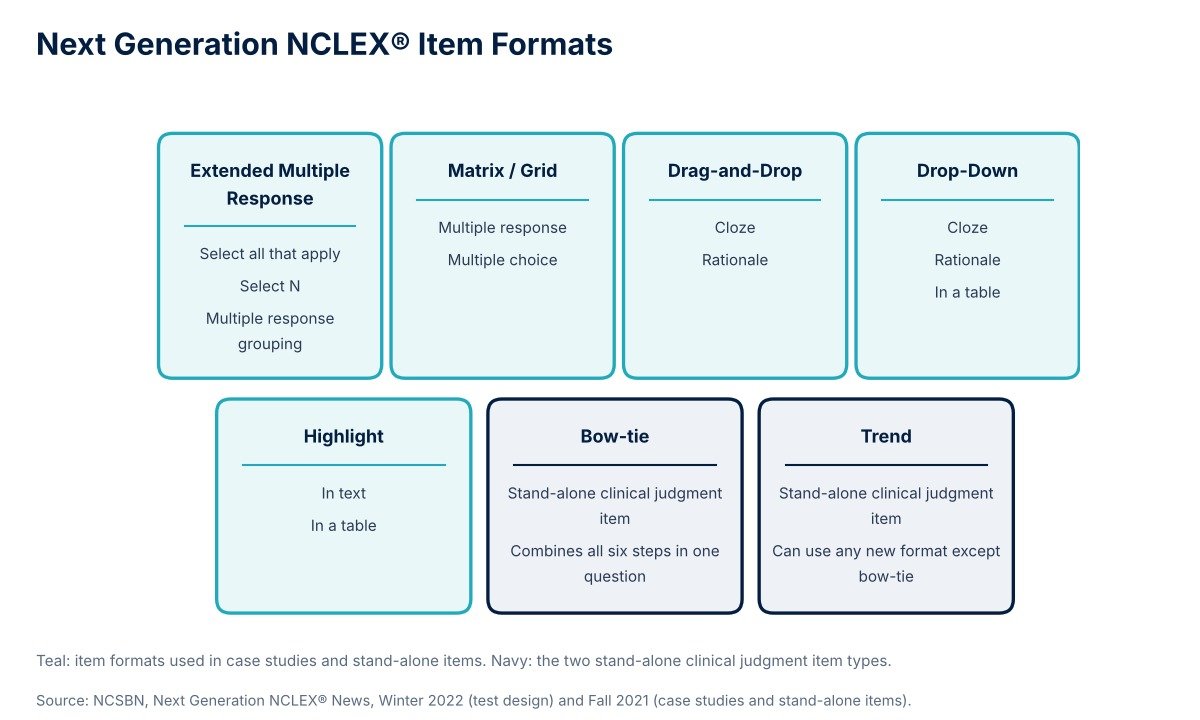
- Extended multiple response: select-all-that-apply questions with more options, including select N, where you choose an exact number, and grouping questions.
- Matrix or grid: a table where you choose one response, or several, for each row or column.
- Drag-and-drop: you move options into blanks within a sentence or a rationale.
- Drop-down: you choose the missing word or phrase from a list inside a sentence or table.
- Highlight: you select the parts of a passage or table that answer the question.
Items with more than one correct answer can earn partial credit. NCSBN uses three scoring methods for this, called plus/minus, zero/one, and rationale scoring.
How to Prepare for the NGN Exam
Preparation for the Next Generation format is mostly a matter of rehearsing the reasoning chain and getting comfortable with the screens. Rereading notes will not do either. Practice that asks you to commit to an answer and then explains the reasoning does both, and it is built into the licensure study resources for each exam track at PrepNurse.ai.
Read the Whole Record Before You Answer
Case study and stand-alone questions place information in tabs. Open every tab before you choose anything, and note which findings are new, which are abnormal, and which are only background. The most common avoidable error is answering from the first finding you notice, when the question depends on how several findings fit together.
Practice Habits for the NGN NCLEX Format
- Practice each format on its own until the mechanics are automatic, then mix them.
- When a question says to select a specific number of responses, choose exactly that number.
- Remember that once you confirm an answer and move on, you cannot go back to it.
- After every question, read the rationale and name the cue that should have led you to the answer.
Pacing matters because the five-hour limit includes breaks and each case study question introduces new information to read. Steady practice with realistic layouts helps you read each record efficiently without rushing the decision itself.
The free plan includes the Question of the Day plus Quick 10 and Quick 20 sets, and Premium adds modes such as Timed Quiz, AI Quiz, and Diagram Quiz. Rotating through the available quiz modes gives you repeated exposure to different layouts.
You can compare the free and Premium plans to see which formats and tools fit your timeline.
For RN and PN Candidates
Both exams use the same six clinical judgment steps, three case studies, and roughly 10% stand-alone items, but the content inside them follows each exam's own test plan. Registered nurse candidates can read the registered nurse exam overview for the RN content areas and scoring rules.
Practical and vocational nurse candidates should use the practical nurse exam overview, because Coordinated Care and the LPN/VN scope of practice shape how clinical judgment questions are written for that exam.
If you are unsure which track or study path fits your situation, you can talk with the support team before you begin.
Next Gen NCLEX® Frequently Asked Questions
What is the Next Gen NCLEX?
The Next Generation NCLEX, often shortened to NGN, is the current design of the NCLEX-RN and NCLEX-PN exams. Since April 2023 it has measured clinical judgment directly through case studies and stand-alone clinical judgment items, and it uses several interactive question formats alongside traditional multiple choice.
What question types are on the Next Gen NCLEX?
NCSBN groups the formats into extended multiple response, matrix or grid, drag-and-drop, drop-down, and highlight questions, plus two stand-alone clinical judgment types called bow-tie and trend. Traditional multiple choice questions are still used.
How many case studies are on the Next Gen NCLEX?
Each exam includes three case studies. Every case study has six questions, one for each step of the clinical judgment model, so the shortest exam contains 18 case study questions. About 10% of the stand-alone questions are clinical judgment items.
What is the difference between a bow-tie and a trend question?
A bow-tie question combines all six clinical judgment steps in one item. You place the most likely condition, two actions to take, and two parameters to monitor. A trend question addresses one or more steps using client information that changes over time, and it can use any new response format except the bow-tie.
Is the Next Gen NCLEX adaptive?
The exam as a whole uses computerized adaptive testing. Within a case study, however, the six questions are fixed and the exam does not adapt, because the questions follow one client's situation from start to finish.
Do both the NCLEX-RN and NCLEX-PN use the Next Gen format?
Yes. Both test plans describe three clinical judgment case studies and about 10% stand-alone clinical judgment items, built on the same six steps. The clinical content inside them follows each exam's own test plan.
Start Practicing at Your Own Pace
Preparation works best when it is steady, honest about weak areas, and focused on understanding why answers are right. PrepNurse.ai offers a free plan that needs no credit card, so you can answer your first questions, read the rationales, and see where you stand today.
PrepNurse.ai is an independent study resource and is not affiliated with or endorsed by NCSBN. NCLEX®, NCLEX-RN®, and NCLEX-PN® are registered trademarks of NCSBN. PrepNurse.ai is a study aid and does not guarantee an exam result.