
How Many Questions Are on the NCLEX? RN and PN Limits

Candidates searching how many questions are on the NCLEX want one reassuring number, but the real answer is a range. The NCLEX-RN and NCLEX-PN both ask between 85 and 150 questions, and the exact count depends on how your answers compare with the passing standard. Neither a short exam nor a long one tells you whether you passed.
PrepNurse.ai is an AI-powered NCLEX practice app, and the numbers here come from NCSBN's 2026 candidate bulletin and its 2025 exam statistics.
How Many Questions Are on the NCLEX? The RN and PN Range
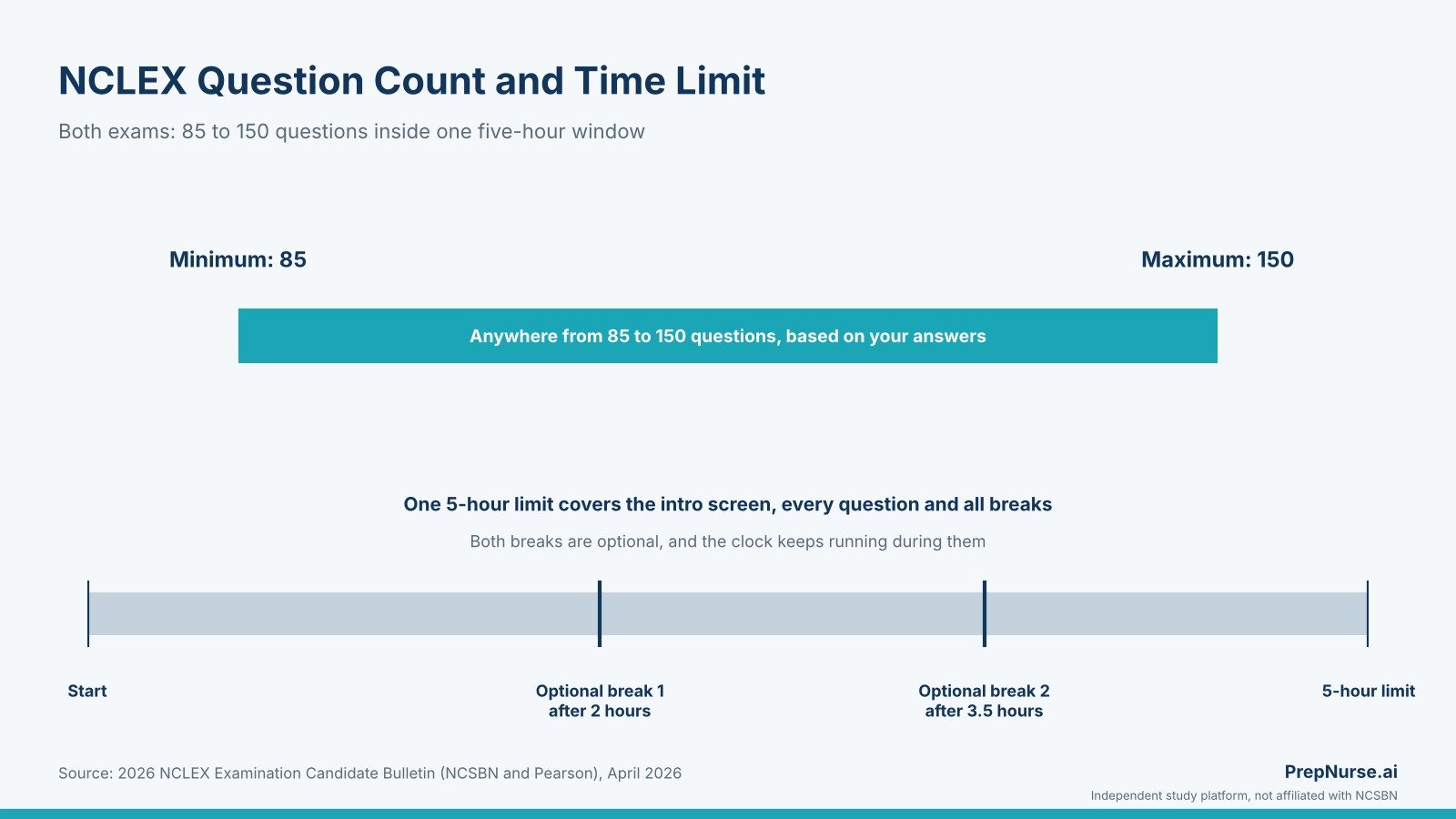
The NCLEX-RN and NCLEX-PN each give you between 85 and 150 questions, and you have five hours to finish.
Older study materials still list higher maximums, up to 265 questions for the RN exam and 205 for the PN exam. Those limits belong to earlier versions of the exam, and NCSBN's 2026 candidate bulletin states that both exams now run 85 to 150 items.
| Measure | NCLEX-RN | NCLEX-PN |
|---|---|---|
| Minimum questions | 85 | 85 |
| Maximum questions | 150 | 150 |
| Time limit | 5 hours | 5 hours |
| Average questions answered | 103 | 100 |
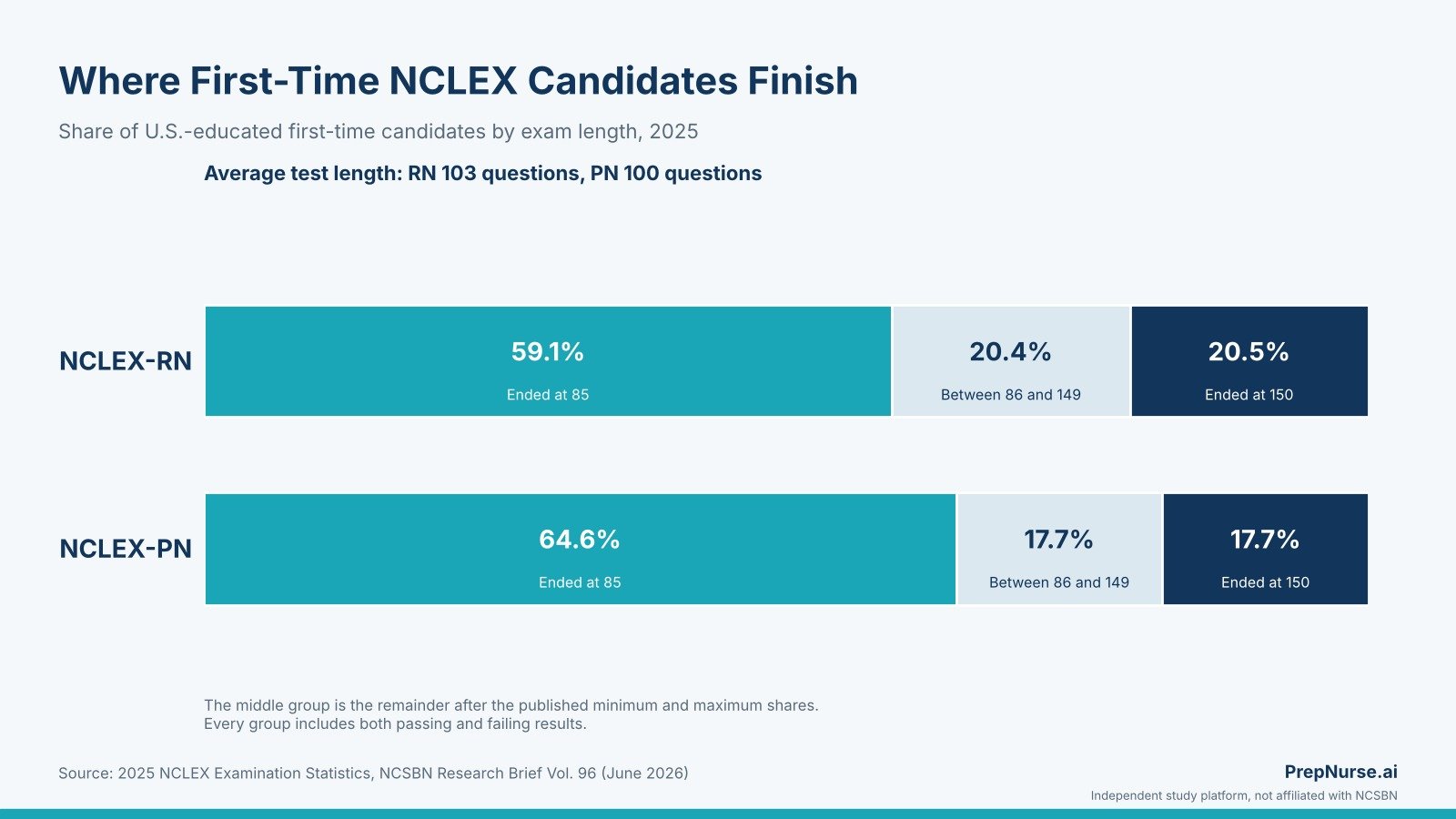
| Candidates who finished at the minimum | 59.1% | 64.6% |
| Candidates who reached the maximum | 20.5% | 17.7% |
| Average testing time | 2 hours 14 minutes | 2 hours 18 minutes |
| Candidates who used all five hours | 0.5% | 0.7% |
How Many Questions Are on the NCLEX-RN?
The registered nurse licensure exam asks 85 to 150 questions. A standard exam carries 15 unscored pretest items, which leaves 70 scored items at the minimum length and 135 at the maximum. In 2025, the average first-time U.S.-educated RN candidate answered 103 questions, and 59.1% finished at 85.
How Many Questions Are on the NCLEX-PN?
The practical nurse licensure exam also asks 85 to 150 questions. First-time U.S.-educated PN candidates averaged 100 questions in 2025, and 64.6% finished at the minimum, a slightly larger share than on the RN exam.
NCLEX Minimum and Maximum Questions: What 85 and 150 Mean
Neither the minimum nor the maximum predicts the result. The count only shows how quickly the computer reached a decision.
What It Means If NCLEX Shuts Off at 85 Questions
Stopping at 85 means the computer became 95% certain, as early as it was allowed to decide, that your ability was clearly above or clearly below the passing standard. It does not say which side. In 2025, 59.1% of first-time U.S.-educated RN candidates and 64.6% of PN candidates finished at the minimum, and those groups included both passes and failures.
What It Means If You Receive All 150 Questions
Receiving 150 means your ability sat close enough to the passing standard that the computer could not reach 95% certainty sooner. At the maximum it waives that rule and decides from the final ability estimate: at or above the standard passes, and below it fails. Roughly one in five first-time RN candidates (20.5%) and 17.7% of PN candidates reached 150 in 2025.
The Run-Out-of-Time Rule
If the five hours expire before 150 questions and before the computer reaches 95% certainty, the result depends on how many questions you answered. Fewer than 85 is an automatic fail, and 85 or more is scored from your final ability estimate.
| Rule | When it applies | Outcome |
|---|---|---|
| 95% confidence rule | After at least 85 questions, once the computer is 95% certain your ability is clearly above or below the standard | The exam stops. Above the standard passes and below it fails. |
| Maximum-length rule | You reach 150 questions without 95% certainty | The final ability estimate decides. At or above the standard passes. |
| Run-out-of-time rule | Five hours end before the computer decides | Fewer than 85 questions fails. 85 or more is scored from the final ability estimate. |
Candidates who do not pass can retest after at least 45 test-free days, and the retake rules and fees explain how that process works.
How Long Is the NCLEX? Time Limit and Breaks
The time limit is five hours for both exams, and that clock covers the introductory screen, every question, and all breaks. Two optional breaks are offered automatically, after two hours and after three and a half hours of testing. The exam clock keeps running during scheduled and unscheduled breaks.
Pacing is rarely the problem. The average first-time RN candidate used 2 hours and 14 minutes, and at 150 questions five hours works out to an average of two minutes per question. The one pacing habit to avoid is rapid guessing, because the computer reads it as lower ability and serves easier items.
What Happens During the Exam, Question by Question
Check-in comes first. Plan to arrive at least 30 minutes early, present valid photo identification that matches your registration exactly, and complete a security check and palm vein scan. A candidate who arrives more than 30 minutes after the scheduled time may forfeit the appointment.
Inside the testing room you receive an erasable noteboard and marker, and an on-screen calculator is available during the exam. Phones, smart watches, and study notes stay in your locker, and you may not discuss or copy exam items at any point.
- Before question 1: a short introductory screen, which counts toward the five-hour limit.
- Questions 1 to 85: every candidate answers at least 85 questions before the computer is allowed to stop the exam.
- Questions 86 to 150: the exam continues only while the computer is still uncertain whether your ability is above or below the standard.
- Breaks: the computer offers optional breaks after two hours and three and a half hours, and you raise your hand to request any other break.
- Finish: a brief questionnaire about your testing experience appears, and then you raise your hand so the test administrator can dismiss you.
No result is shown at the test center, and test center staff cannot see it. Your board of nursing releases the official result.
How NCLEX Chooses Each Question
Every item is selected using three criteria: it must fit the test plan percentages, it must tell the computer as much as possible about your ability, and it must be new to you if you are a repeat candidate. The computer targets items you have about a 50% chance of answering correctly, which is why the exam feels hard for nearly everyone.
The exam could end at any point after question 85, so the test plan percentages must hold at every stage. A minimum-length exam still samples every client needs category, and the content weights by category apply whether you answer 85 questions or 150.
You may also meet an item that looks similar to an earlier one. NCSBN notes that it is incorrect to assume a similar item appeared because you missed the first, since several items can address the same condition at different phases of the nursing process, and an unscored pretest item can resemble a scored one. Answer each item on its own merits.
How Many NCLEX Questions Are Scored?
The 15 unscored pretest items are mixed in with scored questions and cannot be identified. NCSBN analyzes them, and those that meet its statistical standards can become scored items on future exams. At the minimum length, 70 of the 85 questions count toward your result.
How Case Studies Count Toward the Total
Case study items count toward the 85 to 150 total. Each exam includes 18 case study items arranged as three sets of six, so at 85 questions the 70 scored items are 18 case study items plus 52 others. The case study and clinical judgment item formats are worth practicing before test day.
How to Prepare for a Variable-Length Exam
Preparing for 85 to 150 questions means building the same steady focus at question 85 and at question 150. Do not count questions during the exam, because the number on the screen cannot tell you how you are doing. NCLEX study resources at PrepNurse.ai are built around scenario practice with detailed rationales.
| Habit | Why it works |
|---|---|
| Practice 10 to 20 questions every day | Builds consistency without burnout and matches how the exam rewards steady judgment |
| Read the rationale for every answer option | Wrong options expose the reasoning errors the exam is designed to catch |
| Run longer timed sessions before test day | Builds stamina for 150 questions and a five-hour window |
| Review by client needs category | The exam samples every category even when it stops at 85 |
| Decide your break plan in advance | Both breaks are optional and the clock keeps running, so choose when you will use them |
A week-by-week study schedule turns those habits into a calendar you can follow.
For a longer walkthrough of study methods, this step-by-step RN preparation walkthrough covers each stage of preparation.
PrepNurse.ai offers a Question of the Day plus Quick 10 and Quick 20 quizzes, covered in the short daily quiz formats, and each question comes with a detailed rationale.
The free plan includes daily study tools, short practice quizzes, and basic progress tracking with no credit card required. When you want full access, you can compare PrepNurse.ai membership options.
New to the exam itself? An overview of what the exam is and who takes it covers the basics before you plan your practice.
Frequently Asked Questions About NCLEX Question Counts
Is 85 questions bad on the NCLEX?
No. Stopping at 85 only means the computer became 95% certain, as early as the rules allowed, that your ability was clearly above or clearly below the passing standard. It does not say which side. In 2025, 59.1% of first-time U.S.-educated RN candidates and 64.6% of PN candidates finished at 85 questions.
Can you pass the NCLEX with 150 questions?
Yes. At 150 questions the computer waives the 95% certainty rule and decides from your final ability estimate: at or above the passing standard is a pass, and below it is a fail. About 20.5% of first-time U.S.-educated RN candidates reached 150 questions in 2025.
How many NCLEX questions are scored?
A standard exam includes 15 unscored pretest items, so 70 to 135 questions count toward your result. Pretest items look identical to scored items, which is why every question deserves full effort.
What is the average number of questions on the NCLEX?
In 2025, first-time U.S.-educated candidates answered an average of 103 questions on the NCLEX-RN and 100 questions on the NCLEX-PN, according to NCSBN.
How long does it take to get NCLEX results?
No result appears at the test center. Your board of nursing sends official results, usually within six weeks, though timing varies. Many states also offer Quick Results, an unofficial result two business days after the exam for a small fee.
Has the number of NCLEX questions changed?
Yes. Earlier versions allowed up to 265 questions on the RN exam within six hours and up to 205 on the PN exam within five hours. The 2026 NCLEX-RN and NCLEX-PN both run 85 to 150 questions within five hours.
The number of questions on your exam is a measurement result, not a verdict, and the best response is steady practice that works at any length. Want help choosing a starting point? Contact the PrepNurse.ai team and we will help you get started.
PrepNurse.ai is an independent study platform and is not affiliated with or endorsed by NCSBN. NCLEX, NCLEX-RN, and NCLEX-PN are registered trademarks of NCSBN.