
What Is NCLEX? Meaning, Format, and Who Takes It

Every nursing graduate eventually asks what is NCLEX, because it is the last gate between a nursing degree and a nursing license. NCLEX is the national licensing exam that RN and PN graduates must pass before a board of nursing allows them to practice. It is computerized, it adapts to each candidate, and it is built to test safe clinical judgment rather than classroom recall.
PrepNurse.ai is an AI-powered NCLEX practice app, and every figure here comes from NCSBN's 2026 candidate bulletin or its 2025 exam statistics.
What Is NCLEX and What Does NCLEX Stand For?
NCLEX stands for National Council Licensure Examination, the standardized exam that nursing graduates must pass to earn an RN or practical nurse (PN) license in the United States, and the RN version is also used for licensure in Canada.
The National Council of State Boards of Nursing (NCSBN) develops the exam, Pearson VUE delivers it at test centers, and each state or territorial nursing regulatory body decides who is eligible and who receives a license. Boards use NCLEX results as a major input in licensure decisions, and only boards can release official results to candidates.
- Full name: National Council Licensure Examination
- Two versions: NCLEX-RN for registered nurses and NCLEX-PN for practical and vocational nurses
- Format: computerized adaptive testing (CAT), the only format NCLEX is offered in
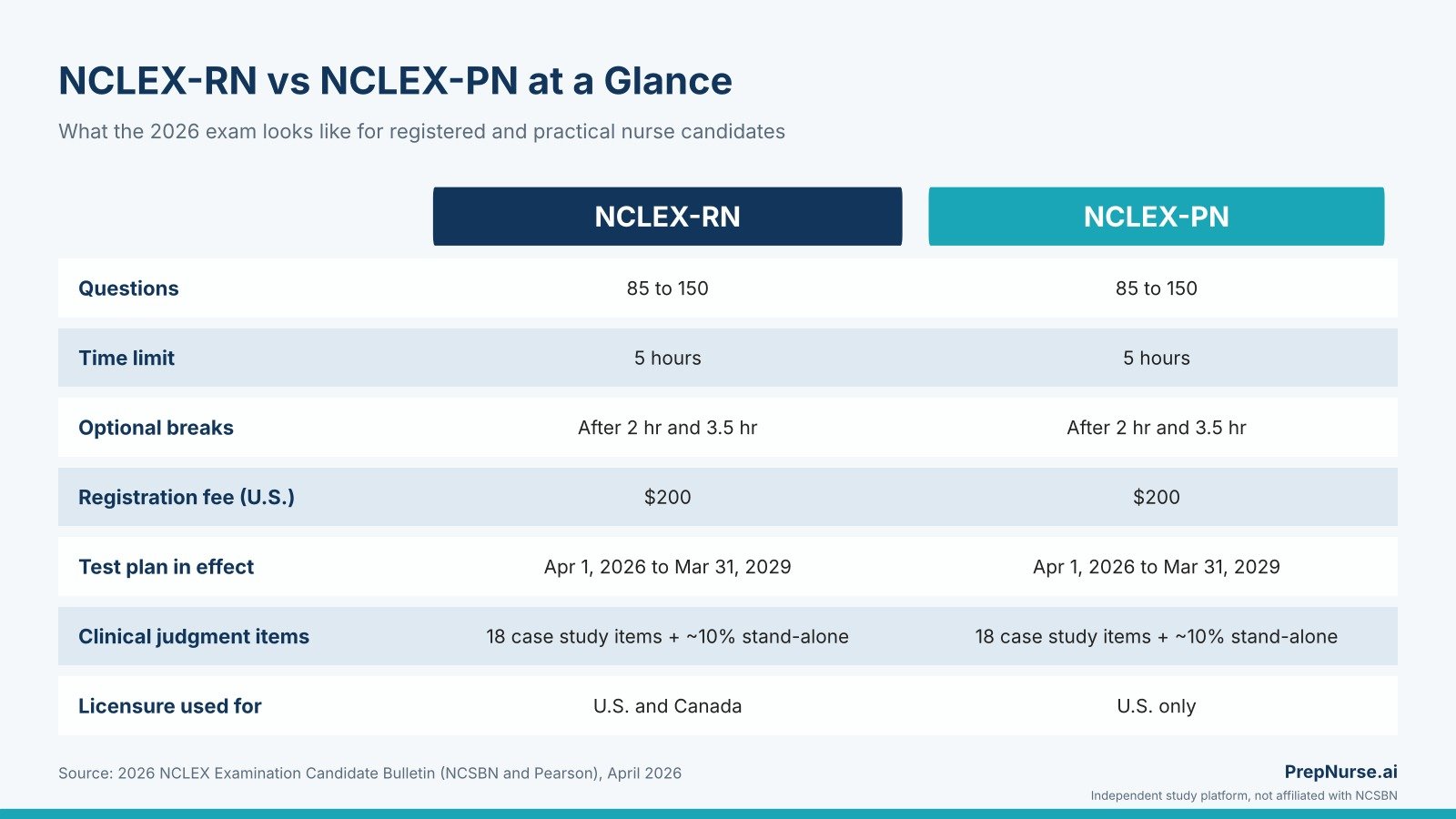
- Length: 85 to 150 questions within a five-hour limit
- U.S. registration fee: $200
- Result: pass or fail, never a percentage score
What Is NCLEX Designed to Measure?
NCLEX tests the knowledge, skills, and abilities needed for safe and effective entry-level nursing practice. Most items are written at the application level or higher, so the exam asks what you would do for a client, not what a term means.
The test plan builds in clinical judgment, which NCSBN defines as an iterative process with six steps:
- Recognize cues
- Analyze cues
- Prioritize hypotheses
- Generate solutions
- Take action
- Evaluate outcomes
Those steps explain why memorizing isolated facts fails candidates. A question about a client with new confusion and falling oxygen saturation is really asking which cue matters most and what you do first.
Who Writes and Scores NCLEX?
NCSBN studies entry-level nursing practice every three years and uses the findings to update each test plan. Nursing instructors write the items, a second panel of practicing nurses reviews them for accuracy, and every item is pretested before it counts toward anyone's result. Each exam is scored twice, once by the computer at the test center and again after the record reaches Pearson.
The NCSBN Board of Directors reevaluates the passing standard every three years. In April 2026 it kept the NCLEX-RN standard at 0.00 logits and the NCLEX-PN standard at -0.18 logits, and the 2026 test plans stay in effect through March 31, 2029.
How the NCLEX Exam Works: Format, Length and Question Types
NCLEX is offered only as a computerized adaptive test. Candidates take it on a computer at a test center with an on-screen calculator available, and no paper or oral version exists.
Computerized Adaptive Testing (CAT)
After each answer, the computer re-estimates your ability from every response so far, then selects the next item to give you roughly a 50% chance of answering it correctly. Each selection must also keep your exam in line with the test plan percentages, and a repeat candidate never receives an item seen on a previous attempt.
That design means two candidates rarely see the same questions, and a hard question is a sign the system is working, not a sign you are failing. Rapid guessing backfires on an adaptive exam because it lowers your ability estimate and earns easier items.
How Many Questions Are on NCLEX and How Long It Takes
Both the NCLEX-RN and NCLEX-PN run between 85 and 150 questions, and one five-hour limit covers the introductory screen, every question, and any breaks. Two optional breaks are offered, after two hours and after three and a half hours of testing. In 2025, the average first-time U.S.-educated RN candidate answered 103 questions in 2 hours and 14 minutes. Candidates who want the full picture can read how the 85-to-150 question range works.
| Feature | NCLEX-RN | NCLEX-PN |
|---|---|---|
| Questions | 85 to 150 | 85 to 150 |
| Time limit | 5 hours, including breaks | 5 hours, including breaks |
| Format | Computerized adaptive test | Computerized adaptive test |
| U.S. registration fee | $200 | $200 |
| Average length, first-time U.S.-educated (2025) | 103 questions | 100 questions |
| Used for licensure in | United States and Canada | United States only |
NCLEX Question Types and Case Studies
NCLEX uses multiple item formats, including select-all-that-apply, and NCSBN publishes a free tutorial that shows each one. Every exam includes 18 case study items, which form three sets of six questions built around one client, and about 10% of the remaining items are stand-alone clinical judgment questions. Items with more than one correct response can award partial credit, scored by plus/minus, zero/one, or rationale methods.
Candidates who want to practice before test day can review the case study and clinical judgment item formats in detail.
How NCLEX Decides Pass or Fail
The most common ending is the 95% confidence rule: the computer stops once it is 95% certain your ability is clearly above or below the passing standard. Candidates whose ability sits very close to the standard receive the maximum number of questions, and the final ability estimate decides the result. If time runs out first, a candidate who has not answered the minimum fails, and a candidate who has is scored on the final ability estimate.
Who Takes NCLEX? NCLEX-RN vs NCLEX-PN
Graduates of approved nursing programs take NCLEX, and the program type decides the version. Graduates of RN programs, including diploma, associate degree, and bachelor's programs, take the NCLEX-RN. Graduates of practical or vocational nursing programs take the NCLEX-PN, which is used for U.S. licensure only. The RN exam is also used by Canadian nursing regulators.
The registered nurse licensure exam puts its heaviest weight on management of care (15 to 21% of items) and pharmacological and parenteral therapies (13 to 19%).
The practical nurse licensure exam puts its heaviest weight on coordinated care (18 to 24%) and carries a larger share of psychosocial integrity questions than the RN exam (9 to 15% versus 6 to 12%).
Volume shows how many people sit each exam. In 2025, 192,916 first-time U.S.-educated candidates took the NCLEX-RN and 54,818 took the NCLEX-PN. Another 52,827 internationally educated candidates took the NCLEX-RN for the first time, and 42,513 U.S.-educated candidates retook it.
What Does NCLEX Test? The Four Client Needs Categories
Both exams are organized around four client needs categories, and two of them split into subcategories. Each exam draws from the following ranges in the 2026 test plans.
| Client needs category | NCLEX-RN | NCLEX-PN |
|---|---|---|
| Safe and Effective Care Environment: management of care (RN) or coordinated care (PN) | 15 to 21% | 18 to 24% |
| Safe and Effective Care Environment: safety and infection prevention and control | 10 to 16% | 10 to 16% |
| Health Promotion and Maintenance | 6 to 12% | 6 to 12% |
| Psychosocial Integrity | 6 to 12% | 9 to 15% |
| Physiological Integrity: basic care and comfort | 6 to 12% | 7 to 13% |
| Physiological Integrity: pharmacological (and parenteral) therapies | 13 to 19% | 10 to 16% |
| Physiological Integrity: reduction of risk potential | 9 to 15% | 9 to 15% |
| Physiological Integrity: physiological adaptation | 11 to 17% | 7 to 13% |
Physiological Integrity holds four of the eight rows, which makes it the largest content area on both exams. Six integrated processes also run through every category: nursing process, caring, clinical judgment, communication and documentation, teaching and learning, and culture and spirituality.
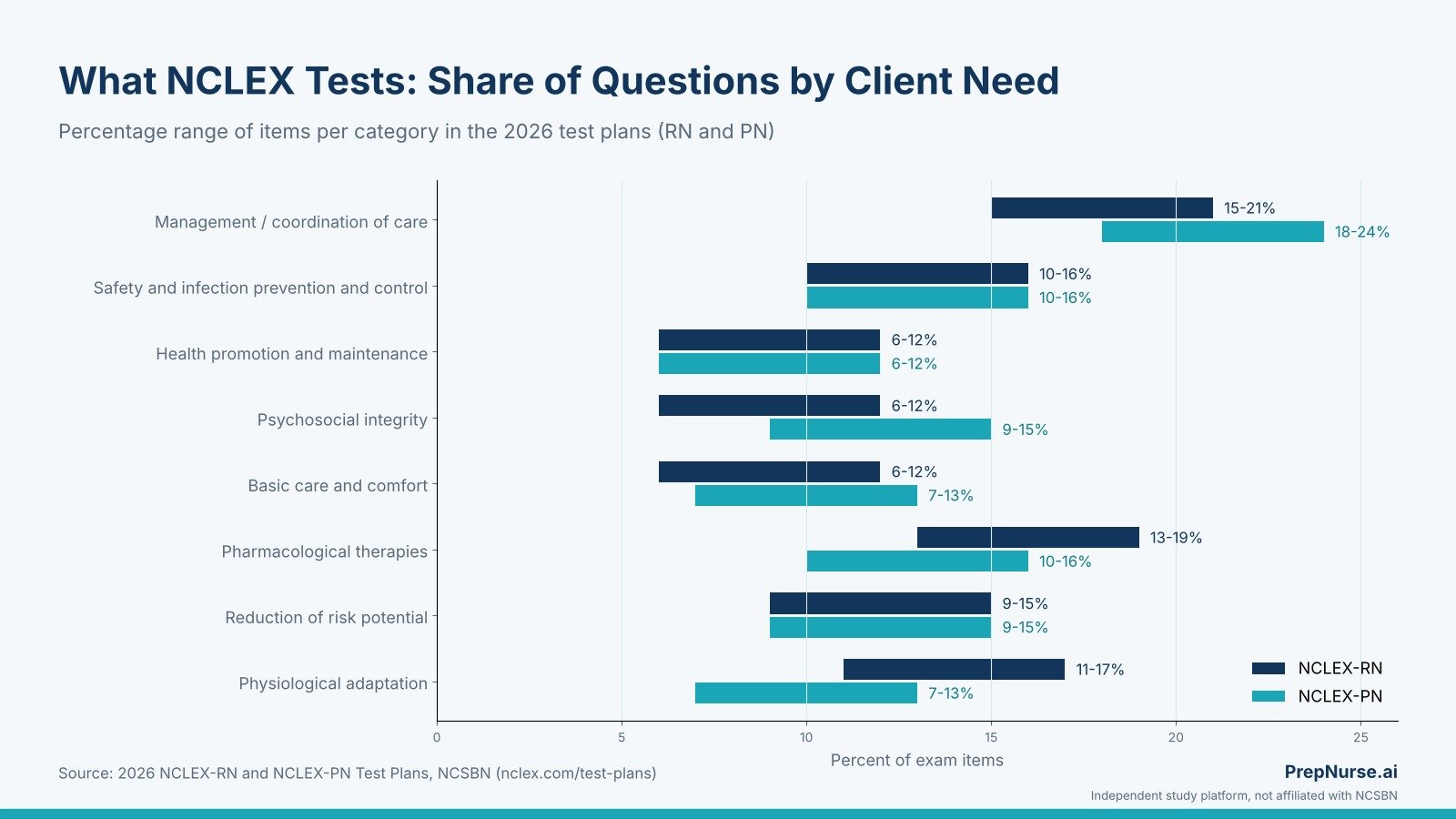
Candidates can use the content weights by client need to decide which categories earn the most practice time.
How Much Does NCLEX Cost?
The NCLEX registration fee is $200 for candidates seeking U.S. licensure, paid to Pearson at registration. Your state board of nursing sets a separate licensure application fee, so ask your board for that amount.
| Fee | Amount |
|---|---|
| Registration fee, U.S. licensure | $200 |
| Registration fee, Canadian licensure | $360 CAD |
| International scheduling fee (testing outside the U.S. and its territories) | $150 additional |
| Change nursing regulatory body after registration | $50 |
| Change exam type (RN or PN) after registration | $50 |
| State licensure application fee | Set by your board of nursing |
Registration fees are not refundable for any reason, including duplicate registrations, missed appointments, and rescheduling without enough notice. Appointment changes must be made at least 24 hours, or one full business day, before the exam.
How to Register for NCLEX
Registration runs through your nursing regulatory body and Pearson, in this order:
- Submit a licensure or registration application to the board where you want to be licensed, and meet its eligibility requirements.
- Register for NCLEX with Pearson online or by phone and pay the fee.
- Receive a registration acknowledgment email from Pearson.
- Wait for your board to declare you eligible in the Pearson system.
- Receive your Authorization to Test (ATT) email.
- Schedule your exam with Pearson.
The ATT is valid for a period set by your board, averaging 90 days, and it cannot be extended. First-time candidates are offered an appointment within 30 days of requesting one, so booking soon after you receive the ATT protects your fee.
NCLEX Exam Day Requirements
Arrive at least 30 minutes early with one valid, government-issued, non-expired, physical photo ID that includes a signature. The first and last names must match your registration exactly, or you will be turned away and must pay again. Phones, smart watches, and notes stay out of the testing room, and every candidate completes a security check and palm vein scan before entering.
NCLEX Passing Score and Pass Rates
NCLEX reports only pass or fail, never a numeric score or percentage. You pass when your ability estimate is at or above the passing standard, which is 0.00 logits for the NCLEX-RN and -0.18 logits for the NCLEX-PN. No fixed percentage of candidates passes or fails in any year.
| Candidate group | NCLEX-RN | NCLEX-PN |
|---|---|---|
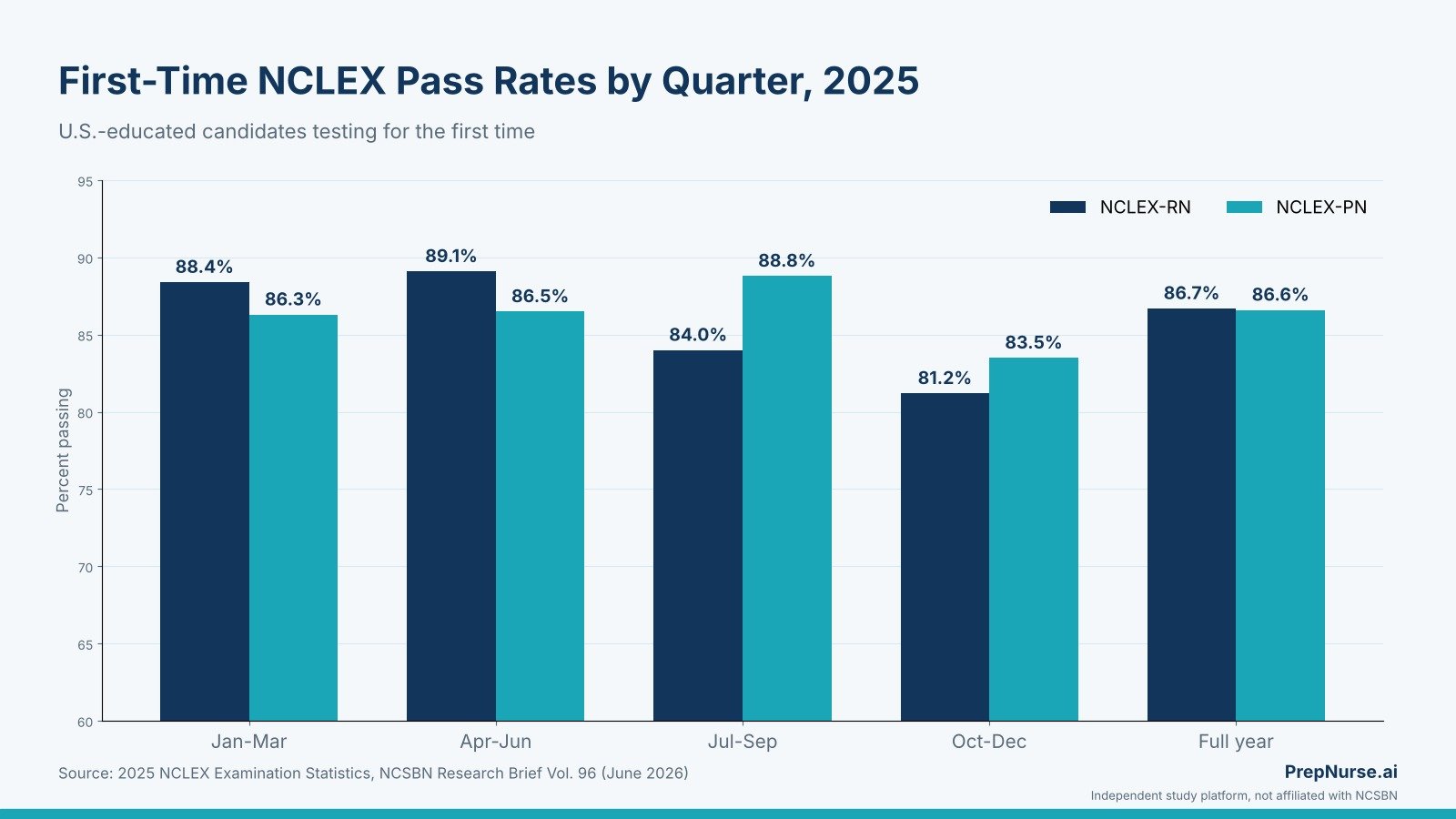
| First-time, U.S.-educated | 86.7% (167,272 of 192,916) | 86.6% (47,470 of 54,818) |
| Repeat, U.S.-educated | 52.7% | 41.7% |
| First-time, internationally educated | 47.3% | 53.7% |
| All candidates | 69.1% | 77.3% |
Is NCLEX Hard?
NCLEX is demanding, but most well-prepared graduates pass: 86.7% of first-time U.S.-educated RN candidates passed in 2025. Quarterly rates ranged from 81.2% to 89.1%, and repeat candidates passed at 52.7%, which shows how much a targeted plan matters on the first attempt.
What Happens After NCLEX?
No result appears at the test center. Official results come only from your board of nursing, usually within six weeks, though timing varies by board. Many states also offer Quick Results, an unofficial result available two business days after the exam for a small fee through your Pearson account, but not every state participates.
Candidates who do not pass receive a Candidate Performance Report that confirms the result, lists the number of items administered, and summarizes relative strengths and weaknesses by test plan category. NCSBN's retake policy allows up to eight attempts a year with at least 45 test-free days between them, and boards add their own conditions. The full retake rules and state variations explain how to plan the next attempt.
How to Prepare for NCLEX
Preparation that works mirrors the exam: scenario-based questions, a detailed rationale for every answer, and steady daily practice. NCLEX study resources at PrepNurse.ai follow that approach, with AI-powered quizzes that explain why each option is right or wrong.
Best Way to Practice for NCLEX Questions
- Answer scenario-based questions every day instead of cramming on weekends.
- Read the rationale for every option, including the ones you got right.
- Track which client needs categories cost you the most points and practice those first.
- Run timed sessions as test day gets closer to build pacing and stamina.
- Review mistakes by asking which cue you missed, not which fact you forgot.
A fixed timeline keeps study sessions honest, so pick a test date and work backward with a week-by-week study schedule.
Candidates who prefer a narrative walkthrough can follow a step-by-step RN preparation walkthrough that covers study methods in more depth.
Short daily sessions build the habit faster than long marathons. PrepNurse.ai offers a Question of the Day plus Quick 10 and Quick 20 quizzes, covered in the short daily quiz formats, and each question comes with a detailed rationale.
For a break from standard questions, interactive clinical decision games such as the Emergency Room Challenge train fast prioritization under time pressure.
The free plan includes daily study tools, short practice quizzes, and basic progress tracking, and no credit card is required. When you want full access, you can compare PrepNurse.ai membership options.
Frequently Asked Questions About NCLEX
What does NCLEX stand for?
NCLEX stands for National Council Licensure Examination. It is the standardized exam developed by NCSBN that nursing graduates must pass to earn an RN or practical nurse (PN) license in the United States, and the RN version is also used for licensure in Canada.
How much does NCLEX cost?
The NCLEX registration fee is $200 for candidates seeking U.S. licensure, paid to Pearson. Your state board of nursing charges a separate licensure application fee, and testing at an international center adds a $150 scheduling fee. Registration fees are not refundable.
Does passing NCLEX make you a nurse?
Passing NCLEX is required for licensure but it is not the only requirement. Your board of nursing must also confirm your education, process your application and complete any background checks before it issues your RN or PN license.
What is the NCLEX passing score?
NCLEX does not report a numeric score or percentage. It reports pass or fail, based on whether your ability estimate is at or above the passing standard, which is 0.00 logits for the NCLEX-RN and -0.18 logits for the NCLEX-PN.
Is NCLEX hard to pass?
NCLEX is demanding because it tests clinical judgment, but most prepared graduates pass. In 2025, 86.7% of first-time U.S.-educated RN candidates and 86.6% of first-time U.S.-educated PN candidates passed, compared with 52.7% and 41.7% of repeat candidates.
Can internationally educated nurses take NCLEX?
Yes, once the board of nursing they apply to declares them eligible. They can test at international centers for an extra $150 scheduling fee. In 2025, 52,827 internationally educated candidates took the NCLEX-RN for the first time and 47.3% passed.
How often does the NCLEX test plan change?
NCSBN reviews entry-level practice every three years and updates the test plans accordingly. The current 2026 NCLEX-RN and NCLEX-PN test plans took effect on April 1, 2026 and remain in effect through March 31, 2029.
Knowing what NCLEX is removes most of the mystery. The exam is a pass-or-fail check that you can make safe decisions as a new nurse, and candidates who pass most often practice real scenarios, read rationales, and arrive with a test date and a plan. Questions about getting started? Contact the PrepNurse.ai team and we will point you to the right starting point.
PrepNurse.ai is an independent study platform and is not affiliated with or endorsed by NCSBN. NCLEX, NCLEX-RN, and NCLEX-PN are registered trademarks of NCSBN.